 Go Back

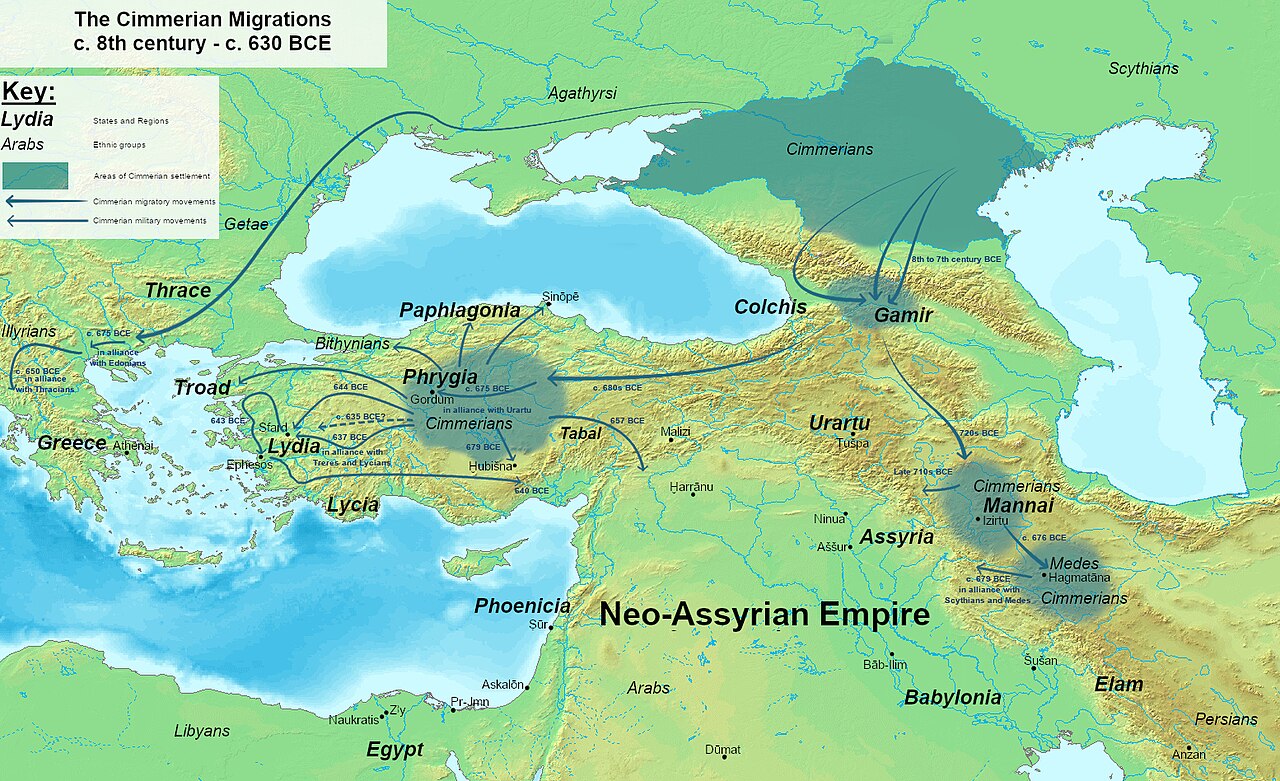
Cimmerians. The Cimmerians were an Eastern Iranic equestrian nomadic people of the Pontic-Caspian steppe, culturally Scythian but politically distinct from the Scythians proper, their relatives who eventually displaced them. They left no writings of their own: almost everything known about them comes from Neo-Assyrian intelligence reports of the 8th-7th centuries BCE, which called them Gimirri, and from later Greek authors, who knew them as Kimmerioi. They were among the first true nomads of the steppe, born of climatic changes around the start of the 1st millennium BCE that turned former farmers into mounted herders.
Pressed by the expanding Scythians, part of the Cimmerians crossed the Caucasus into West Asia in the late 8th century BCE, raiding through the kingdom of Mannai. Their first dated appearance is spectacular: Assyrian reports of 714 BCE record that they crushed a counter-attack by Rusa I of Urartu, capturing his commanders and so weakening that great kingdom that the Assyrian king Sargon II defeated it the same year. In Anatolia they terrified the established powers - King Midas of Phrygia, once Assyria's bitter enemy, sought an anti-Cimmerian alliance with Sargon in 709 BCE - and in 705 BCE Sargon II himself was killed in battle campaigning in Tabal, probably against Cimmerian forces.
Through the 7th century BCE the bulk of the Cimmerians operated in Anatolia, and the disturbances they caused let many local rulers slip free of Assyrian overlordship. Their high point came in 644 BCE, when the Cimmerians and their Treres allies defeated the Lydians and captured Sardis, one of the richest capitals of the age. It could not last: around 635 BCE the Scythians under Madyes, acting with Assyrian approval, entered Anatolia and crushed the Cimmerians alongside the resurgent Lydians, and the survivors faded from the records soon after.
The Cimmerians vanished as a people, absorbed into the populations they had once terrorized, but their name refused to die: Late Babylonian scribes of the Persian Empire went on calling every steppe nomad people 'Gimirri', Scythians and Saka included, long after the real Cimmerians were gone. Their brief, violent passage across West Asia - shattering Urartu's power, helping topple Phrygia's order, taking Sardis - permanently reshuffled the politics of the region, weakening the old kingdoms just as Assyria and then the Medes and Persians rose to dominate it.
 Britannica: Cimmerian
 Encyclopaedia Iranica: CIMMERIANS
 Livius: Cimmerians - Livius
 World History Encyclopedia: Phrygia