 Go Back

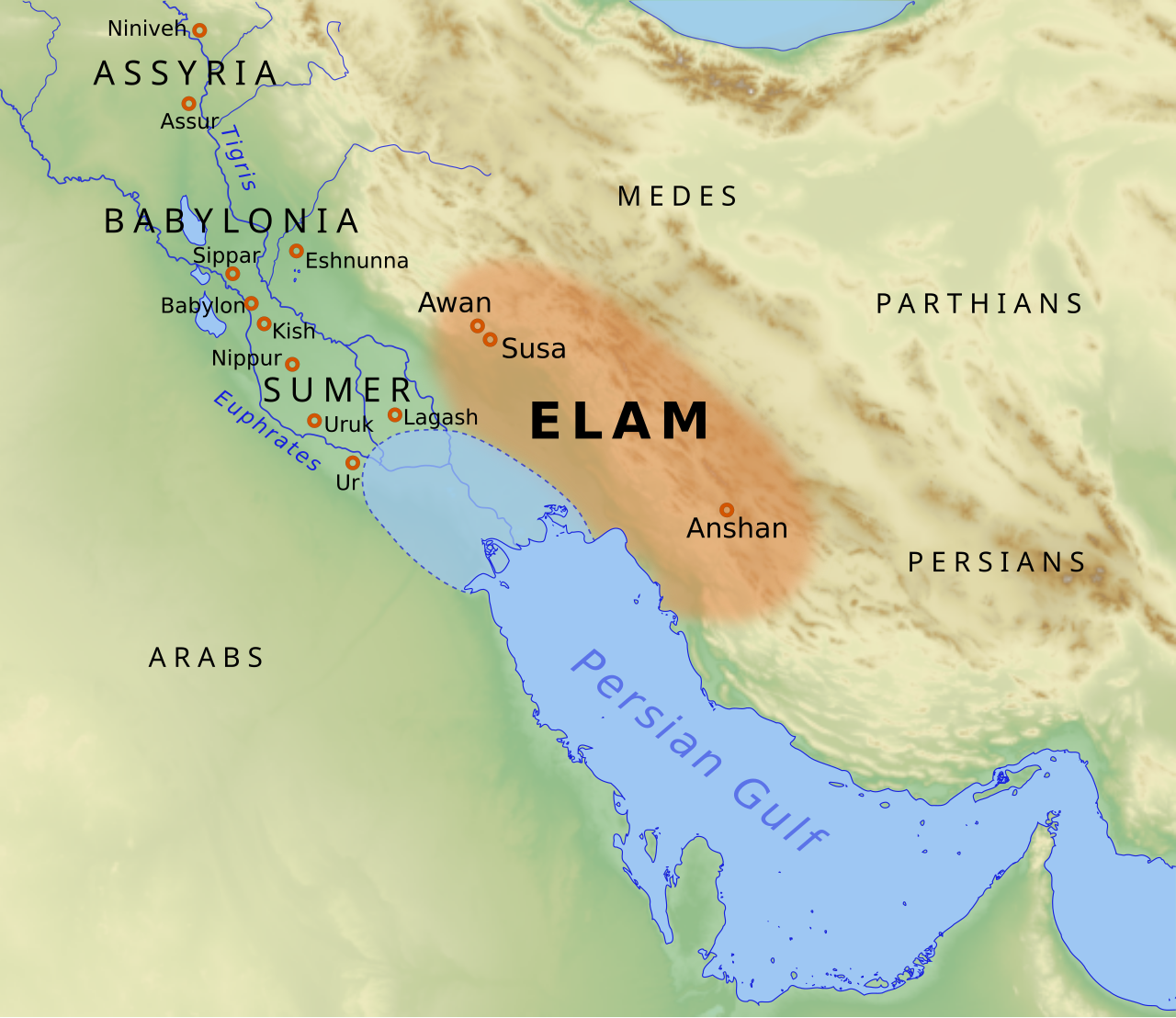
Elam. Elam was an ancient civilization centered in the far west and southwest of modern Iran, from the Khuzestan lowlands to the Zagros highlands around Anshan, known to classical writers as Susiana after its capital, Susa, one of the oldest cities in the world. The Elamite language was an isolate, unrelated to Sumerian, to the Semitic languages, or to the Iranian tongues that came later, and the still-undeciphered proto-Elamite script, appearing around 3000 BCE, ranks among humanity's earliest writing. For more than two thousand years, Elamite states stood among the leading powers of the ancient Near East, astride the routes connecting the Iranian plateau to the cities of Mesopotamia.
Elamite history, reconstructed mostly from Mesopotamian records, was a constant contest with its western neighbors. Sargon of Akkad defeated the Elamite king of Awan and tried to impose the Akkadian language; Elam threw off Akkadian rule under Kutik-Inshushinak, and in 2004 BCE the Elamites under Kindattu sacked Ur itself, ending the Third Dynasty of Ur. In the Sukkalmah period, Elam's 'great kings' were addressed as 'Father' by the rulers of Mesopotamia, including the young Hammurabi - who around 1760 BCE drove the Elamites out and built his own short-lived Babylonian empire. Etched carnelian beads and Indus seals found at Susa show Elam's trade reaching as far as the Indus Valley.
Elam's golden age came in the Middle Elamite period (c. 1500-1100 BCE), when its kings took the title 'king of Anshan and Susa'. King Untash Napirisha raised the great ziggurat of Chogha Zanbil around 1250 BCE, today the best preserved in the world. Under the Shutrukid dynasty the empire reached its height: Shutruk-Nakhkhunte raided Babylonia and carried home trophies including the Stele of Naram-Sin and the very stele bearing Hammurabi's law code - which is why those Mesopotamian masterpieces were found at Susa - and in 1158 BCE the Elamites destroyed Kassite power permanently, briefly placing one of their own on Babylon's throne.
Elam's last centuries were spent resisting the Neo-Assyrian Empire as Babylon's ally. Ashurbanipal broke Elamite power at the battle of Ulai in 653 BCE, sacked Susa in 646, and by 640 had captured the last Elamite king, Humban-Haltash III, annexing and destroying the kingdom. Yet Elam's legacy outlived its state: Persian settlers under Teispes took over Anshan, making it the nucleus of the future Achaemenid dynasty, Elam's administrative traditions became a foundation of Iranian government, and Susa went on to serve as a royal capital of the Persian kings.
 Britannica: Elam
 World History Encyclopedia: Elam: The Ancient High Country
 Encyclopaedia Iranica: ELAM
 Livius: Elam - Livius