 Go Back

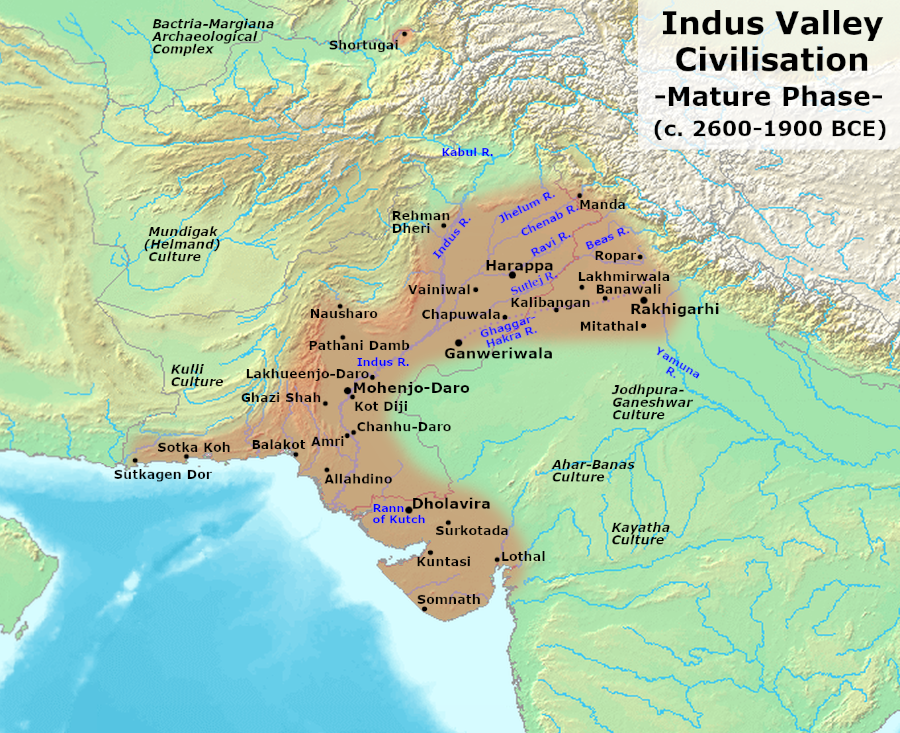
Indus Valley Civilization. The Indus Valley Civilization, also called the Harappan Civilization after its first excavated city, was one of the four great cradles of the ancient world - and in sheer area the largest, spreading over a million square kilometers of what is now Pakistan, northwest India, and northeast Afghanistan, larger than Egypt and Mesopotamia combined. It flourished along the Indus River and the now-faded Ghaggar-Hakra river system from about 3300 to 1300 BCE, reaching its mature phase between 2600 and 1900 BCE, when its population may have numbered between one and five million people.
Its cities were unlike anything else in the Bronze Age: Mohenjo-daro and Harappa, each home to perhaps 30,000-60,000 people, were laid out on planned grids with baked-brick houses, covered drains, wells, and sophisticated water supply - urban sanitation unmatched until the Romans. Mohenjo-daro's Great Bath and massive granaries speak of organized civic life, yet strikingly, archaeologists have found no obvious palaces, temples, or royal tombs, leaving the question of who ruled these cities unanswered to this day.
The Harappans were masters of craft and commerce: their standardized weights, bead-making, and metalwork were exported across the ancient world, and Indus seals and etched carnelian beads have been dug up in Mesopotamia, whose texts speak of a trading land called Meluhha - almost certainly the Indus. They wrote in a script of some 400 signs stamped on thousands of seals, but with no bilingual text and inscriptions only a few symbols long, the Indus script remains undeciphered and their language unknown, though many scholars favor a connection to the Dravidian family.
Around 1900 BCE the cities began to empty. The leading explanation is not invasion but climate: a gradual drying of the region shrank the rivers that fed Harappan agriculture, and the population drifted eastward into smaller rural communities, carrying pieces of their old world with them. The civilization vanished so completely that when Harappa's ruins were first recorded in the 19th century they were mistaken for a city of Alexander's time; only the excavations of the 1920s revealed that South Asia had nursed a civilization as old and as grand as Egypt's - one whose people we can see but whose words we still cannot read.
 Britannica: Indus civilization
 World History Encyclopedia: Indus Valley Civilization
 Humanities LibreTexts: 6.11: The Indus River Valley Civilization
 Khan Academy: Client Challenge