 Go Back

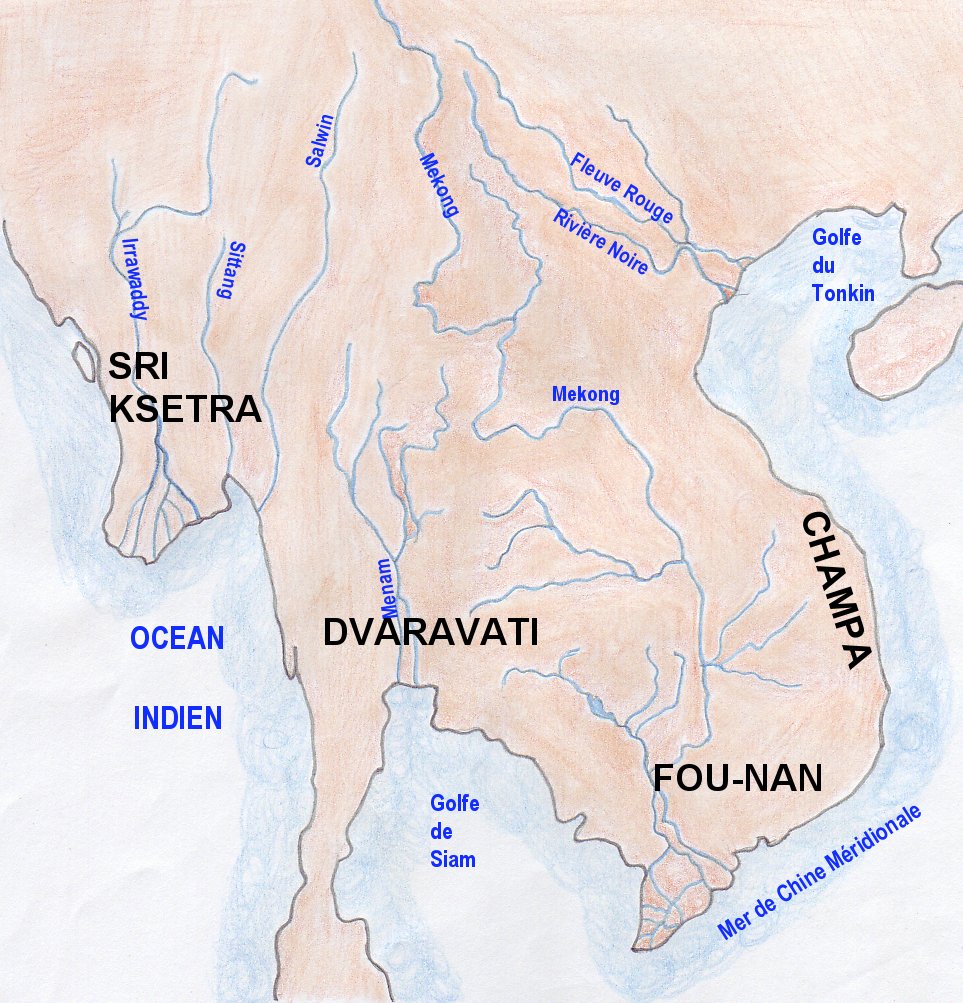
Funan. The kingdom the Chinese called Funan was, so far as we know, the first great state of Southeast Asia: a network of Indianized trading cities centered on the Mekong Delta, flourishing from roughly the 1st to the 6th century CE across what is now southern Vietnam and Cambodia. 'Funan' is not even its real name - no local inscription uses it. It is the Chinese rendering, possibly of an old Khmer word for 'mountain', and everything we know of the kingdom comes from Chinese chronicles and from the soil itself.
Chinese legend gave Funan a foundation myth: the Indian Brahmin Kaundinya, guided by a dream, sailed to the delta, defeated the local serpent-queen Soma in combat, and married her - a story that encodes the historical truth of 'Indianization'. From the early centuries CE, traders, priests, and ideas flowed across the Bay of Bengal, and Southeast Asian rulers adopted Sanskrit, Hindu and Buddhist religion, and Indian concepts of kingship, blending them with local traditions rather than replacing them.
Funan's wealth came from geography. Its cities sat astride the maritime route between India and China, and its great port of Oc Eo, linked by canals to the inland capital near Angkor Borei, was one of the ancient world's busiest entrepots - excavations there have unearthed Roman coins and medallions, Indian gems, and Chinese goods, evidence of trade reaching from Rome to the Han. Chinese envoys Kang Tai and Zhu Ying, who visited in the mid-3rd century, described a kingdom of walled cities, palaces, and taxes paid in gold, silver, and pearls.
From the 5th century, Funan's power waned as trade routes shifted and its upriver vassal, Chenla, grew strong in the interior; by the 7th century Chenla had absorbed its former master, and Funan faded from the record. But its template - the Indianized maritime state living from the straits trade - was inherited by Srivijaya, and its people and traditions were the ancestors of Angkor. Cambodia's royal chronicles traced their kings back to Funan's founding pair, Kaundinya and Soma.
 Britannica: Funan
 Humanities LibreTexts: 11.4: Art of Southeast Asia
 The Metropolitan Museum of Art: Pre-Angkor Traditions: The Mekong Delta and Peninsular Thailand
Britannica: Cambodia - Khmer Empire, Angkor Wat, Genocide