 Go Back

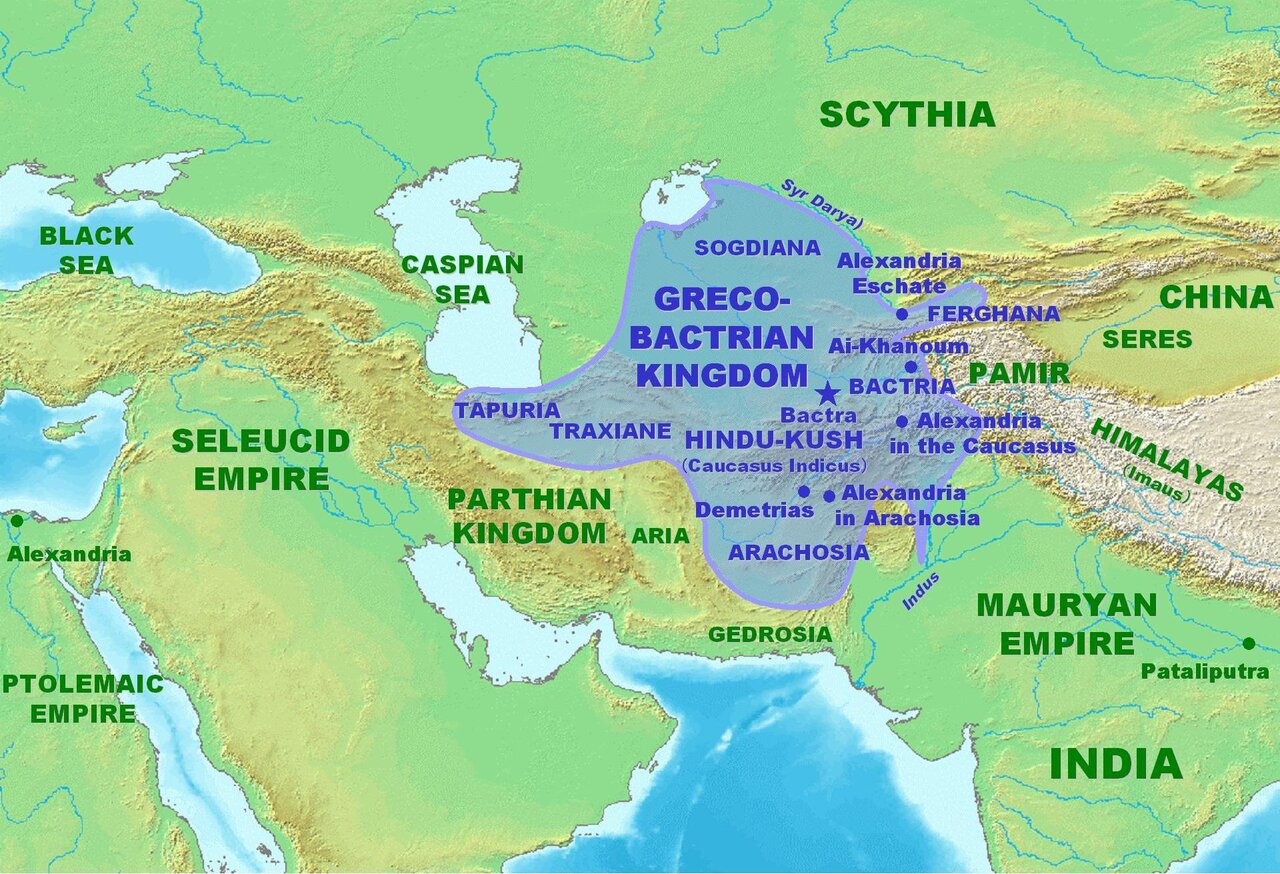
The Greco-Bactrian Kingdom. The Greco-Bactrian Kingdom (c. 256-125 BCE) was the easternmost outpost of the Hellenistic world: a Greek-ruled state in Bactria and Sogdiana (northern Afghanistan and southern Central Asia), a thousand kilometers beyond the other successor kingdoms of Alexander the Great. Its founder, the satrap Diodotus I, broke away from the Seleucid Empire around 256 BCE, and his son Diodotus II was overthrown by Euthydemus I, who famously defended the kingdom's independence against Antiochus III's siege of Bactra (208-206 BCE).
Under Demetrius I (r. c. 200-180 BCE) the Greco-Bactrians crossed the Hindu Kush and conquered northwestern India, founding a whole family of Indo-Greek kingdoms. Their cities were full Greek poleis planted in Central Asia: Ai-Khanoum, on the Oxus, had a theater, a gymnasium, Greek inscriptions of Delphic maxims, and a palace blending Greek and Persian forms. Their kings minted superb silver portraits - among the finest coins ever struck - with Greek on one side and local scripts on the other.
The kingdom's later history was fractious. Eucratides, a rival king, overthrew the Euthydemids around 170 BCE, civil wars multiplied claimants, and the realm split between rulers north and south of the Hindu Kush. Around 145-125 BCE nomad peoples on the move - Sakas and the Yuezhi, the future Kushans - overran Bactria, and the last Greek kings north of the mountains disappeared, though their Indo-Greek cousins ruled in Pakistan and India into the early 1st century CE.
Greco-Bactria matters far beyond its size: it carried Greek art and institutions deep into Asia, created the Greco-Buddhist fusion that produced Gandhara art and the first anthropomorphic images of the Buddha, and sat astride the routes that soon became the Silk Road, linking China, India and the Mediterranean. The Indo-Greek king Menander (Milinda), remembered in Buddhist tradition as the wise questioner of the monk Nagasena, shows how thoroughly these Greek rulers entered the Asian world they had conquered.
 Britannica: Bactria
 World History Encyclopedia: Greco-Bactrian Kingdom
 Encyclopaedia Iranica: BACTRIA i. Pre-Islamic period