 Go Back

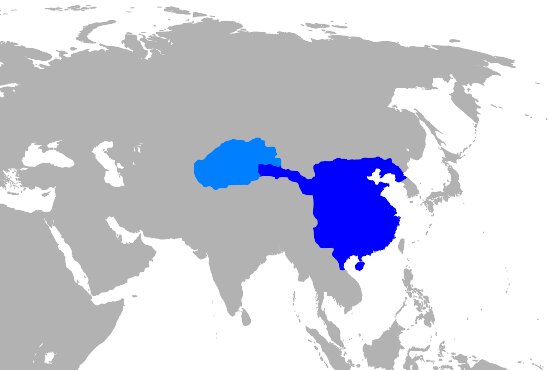
The Han dynasty (206 BCE-220 CE) was China's first great golden age, so central to Chinese identity that the majority of Chinese still call themselves 'people of Han'. Its founder was no aristocrat: Liu Bang, a commoner and minor official, won the civil wars after the Qin empire's collapse and ruled as Emperor Gaozu from his new capital at Chang'an. Where the Qin had exhausted the country with conscription and severity, Gaozu and his early successors restored moderate taxes and peace while keeping Qin's centralized administration - a combination that gave China four centuries of unity and set the pattern every later dynasty would follow.
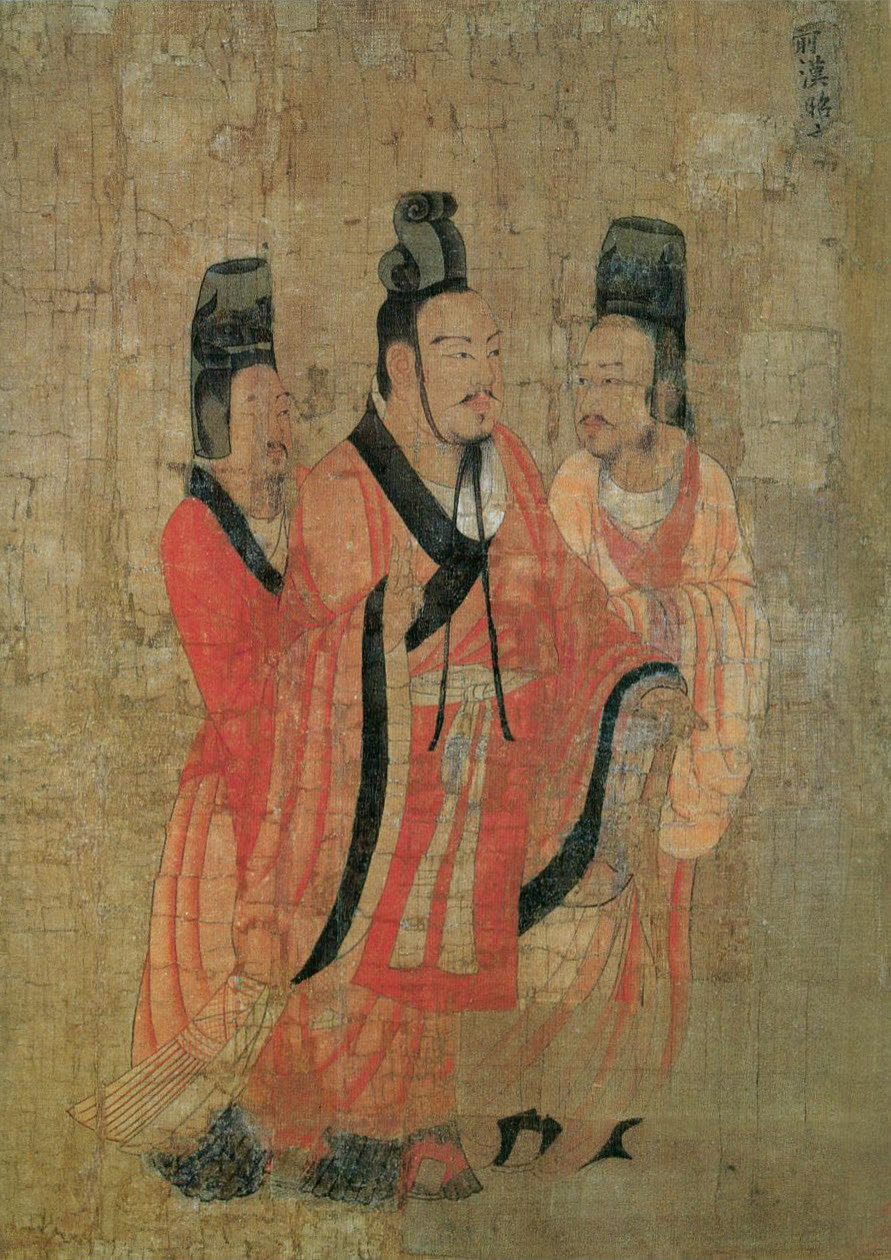
Under Emperor Wu (r. 141-87 BCE), the 'Martial Emperor', Han China became the largest and richest state on earth. His armies broke the power of the Xiongnu, the nomad confederation of the steppe, seized the Hexi Corridor and planted garrisons deep into Central Asia. The envoy Zhang Qian's epic journey to the west opened the Silk Road, the caravan network that would link China to Persia and ultimately Rome. At home Wu made Confucianism the ideology of the state, founded an imperial university to train officials in the classics, and established state monopolies on salt and iron to pay for the wars. It was the age, too, of Sima Qian, whose Records of the Grand Historian set the form of Chinese historical writing for two thousand years.
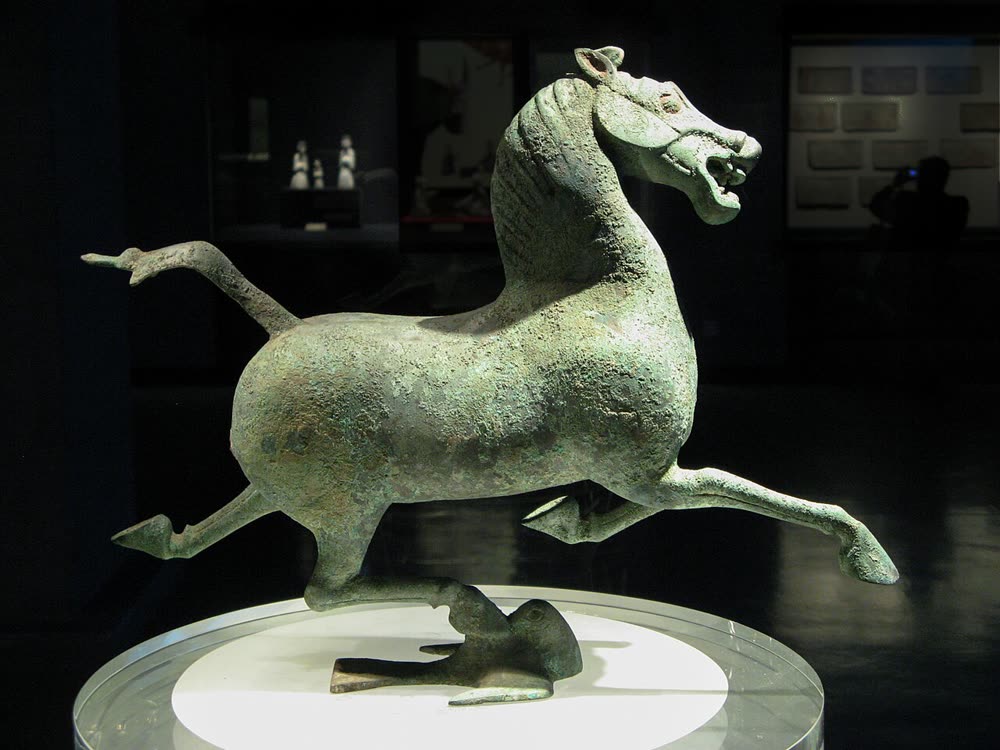
The dynasty's first run ended when the regent Wang Mang declared the Han finished and proclaimed his own Xin dynasty (9-23 CE). His idealistic, heavy-handed reforms failed amid famine and revolt, and after a brief civil war a Han prince restored the dynasty in 25 CE. The restored house - the Eastern or Later Han - reigned for another two centuries from its new capital at Luoyang. It was a second age of prosperity and invention: paper was presented at court in 105 CE, Buddhism entered China from India along the trade routes, and Han workshops produced the wheelbarrow, the seismograph and some of the finest bronzes ever cast.
The end came from within. Through the second century the court hollowed out: palace eunuchs and the clans of empresses fought for control of boy emperors, while great landowning families swallowed up the tax-paying peasantry into their estates. When famine and heavy taxes provoked the massive Yellow Turban Rebellion in 184 CE, the court could suppress it only by arming regional commanders - who then became warlords answerable to no one. By the reign of Emperor Ling (r. 168-189 CE) the imperial house had less real authority than the eunuchs of its own palace and the generals on its borders.
Among those generals was Cao Cao, who made the last Han emperor his puppet, waged war on his fellow commanders, and went down to defeat at the Battle of Red Cliffs in 208 CE, after which China split three ways. In 220 his son Cao Pi formally ended the Han and opened the age of the Three Kingdoms. But the Han model - a Confucian bureaucracy ruling a unified agrarian empire - became China's permanent political ideal, revived by every great dynasty after, and matched in world history only by the Han's great contemporary: Rome.
 Britannica: Han dynasty
 The Metropolitan Museum of Art: Han Dynasty (206 B.C.-220 A.D.)
 World History Encyclopedia: Han Dynasty