 Go Back

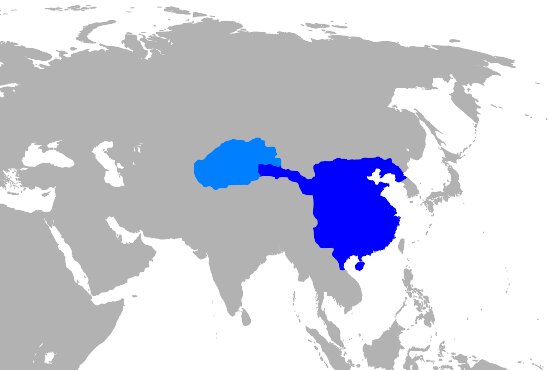
The Han Dynasty. The Han dynasty (206 BCE-220 CE) was China's first great golden age, so central to Chinese identity that the Chinese still call themselves 'people of Han'. Its founder, Liu Bang - a commoner and minor official - won the civil wars after Qin's fall and ruled as Emperor Gaozu, establishing his capital at Chang'an. His successors of the Western Han consolidated the empire, restoring moderate taxes and peace after Qin's exhaustion while keeping its centralized administration.
Under Emperor Wu (r. 141-87 BCE), the 'Martial Emperor', Han China became the largest and richest state on earth. His armies broke the Xiongnu nomad confederation of the steppe, seized the Hexi Corridor, and planted garrisons in Central Asia; his envoy Zhang Qian's journey to the west opened the Silk Road linking China to Persia and Rome. At home Wu made Confucianism the state ideology, founded an imperial university, and established state monopolies on salt and iron to pay for the wars.
After a brief interruption - the reformer-usurper Wang Mang's Xin dynasty (9-25 CE) - the Later or Eastern Han reigned from Luoyang for another two centuries of prosperity: paper was presented at court in 105 CE, Buddhism entered China, and scholars compiled the great histories. But the dynasty slowly rotted from within as palace eunuchs and empresses' clans fought for control, great landowning families swallowed the tax-paying peasantry, and the devastating Yellow Turban Rebellion (184) forced the court to arm regional warlords it could no longer command.
The warlord Cao Cao held the last emperor as a puppet, and in 220 his son Cao Pi formally ended the Han, opening the age of the Three Kingdoms. But the Han model - a Confucian bureaucracy ruling a unified agrarian empire - became China's permanent ideal, matched in world history only by contemporary Rome.
 Britannica: Han dynasty
 The Metropolitan Museum of Art: Han Dynasty (206 B.C.-220 A.D.)
 World History Encyclopedia: Han Dynasty