 Go Back

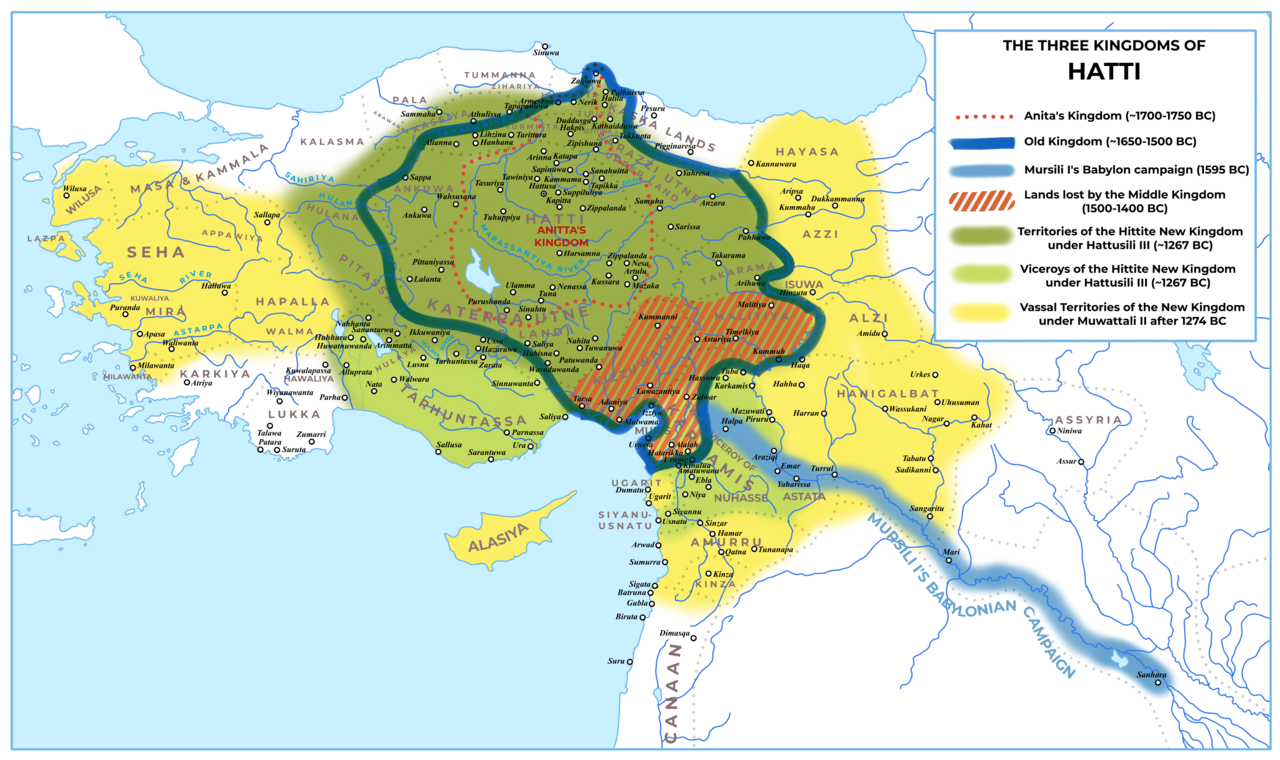
The Hittite Empire was an ancient Anatolian power that dominated modern-day Turkey and northern Syria between about 1650 and 1190 BCE, ruled from its capital at Hattusa, high on the rugged central Anatolian plateau. The Hittites were an Indo-European people who settled in north-central Anatolia early in the 2nd millennium BCE and absorbed the earlier Hattian inhabitants, from whom they took the name of both their land and their capital. Older scholarship credited them with pioneering iron smelting and monopolizing ironworking, giving them an edge over bronze-wielding neighbors, but that view is now contested: Bronze Age iron objects from Anatolia are no more numerous than those from Egypt or Mesopotamia, and most appear to be meteoritic. The Hittite military did make successful use of chariots.
The Hittites also developed a distinctive legal system. Under their law code, crimes such as murder and theft, which were capital offenses in other southwest Asian kingdoms, were punished mainly by restitution, with the thief repaying what was stolen. And where Egypt's pharaohs were worshipped as living gods, the early Hittite king was a first among equals; only after about 1400 BCE did the kingship become centralized and powerful.
The empire reached its peak in the mid-14th century BCE under Suppiluliuma I, when it encompassed most of Anatolia, parts of northern Syria, and Upper Mesopotamia. Hittite prosperity depended on controlling trade routes and metal sources, and that brought collision with the expanding Egypt of Ramesses II at the Battle of Kadesh around 1274 BCE, a hard-fought clash with no clear winner. With Assyria rising as a threat to both, King Hattusili III concluded a peace and alliance with Ramesses around 1258 BCE: the Treaty of Kadesh, among the oldest surviving written peace treaties in history, sealed by the marriage of a Hittite princess to the pharaoh.
In the end it was Assyria and new migrating peoples that broke the kingdom. Much of the empire was annexed by the Middle Assyrian Empire while the remainder was sacked by Phrygian newcomers, and Hattusa itself was abandoned around 1190 BCE during the Late Bronze Age collapse. The Hittites fractured into smaller independent Syro-Hittite states, some of which survived until the 8th century BCE before succumbing to the Neo-Assyrian Empire.
 Britannica: Anatolia - Hittites, Empires, Anatolian Plateau
 World History Encyclopedia: The Hittites
 Humanities LibreTexts: 3.1: Ancient Societies on the Mediterranean
 Livius: Hittites - Livius