 Go Back

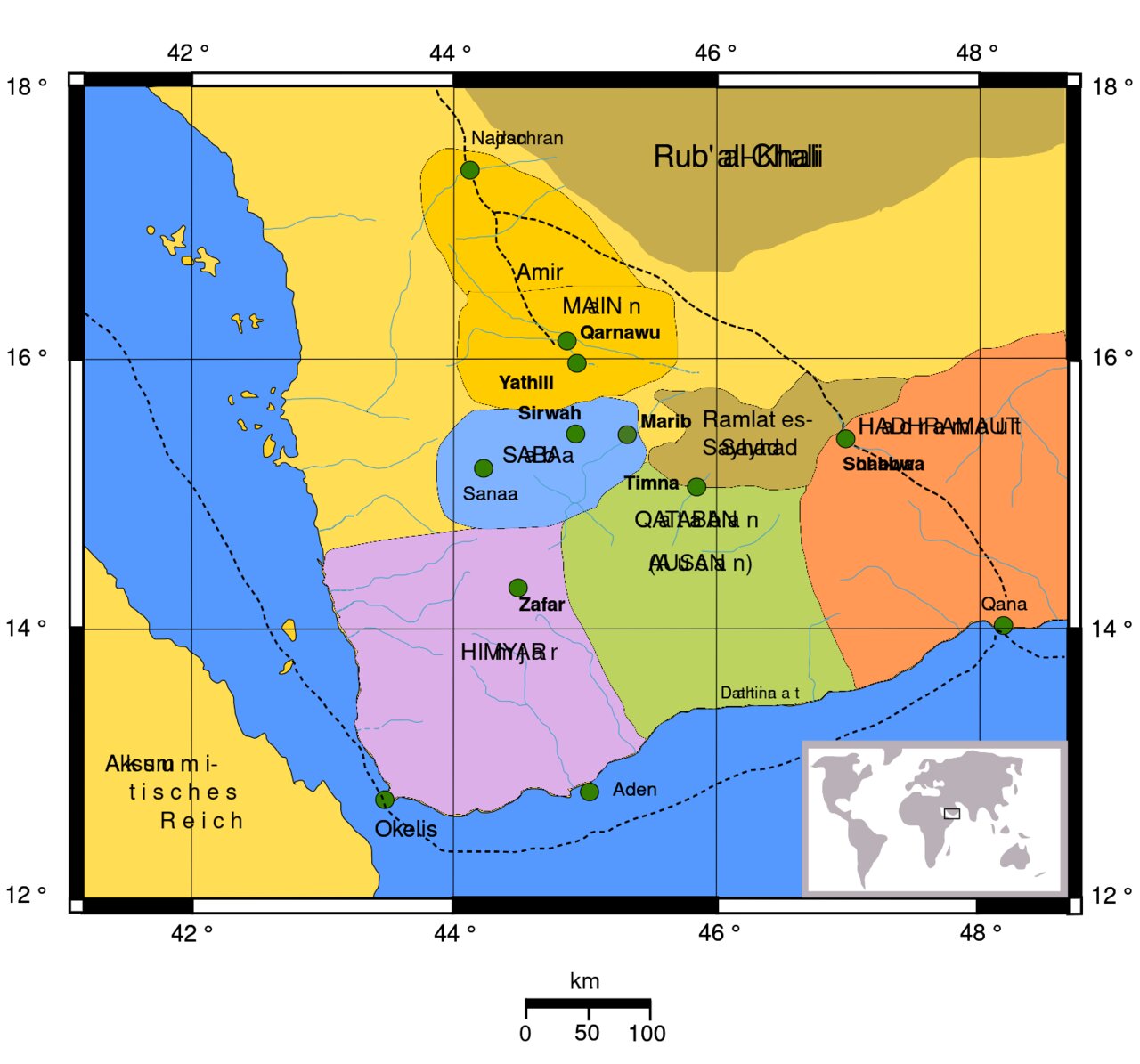
The Kingdoms of Ancient Yemen. In antiquity Yemen was Arabia Felix - 'Happy Arabia' - the one corner of the peninsula blessed with monsoon rains and terraced highland farms, and above all with frankincense and myrrh, the precious resins whose caravans made southwest Arabia rich. From about 1000 BCE a series of literate kingdoms rose there: Saba (Sheba), Ma'in, Qataban, Hadhramawt and Awsan, each with its own gods, temples and monumental inscriptions in the South Arabian script.
Greatest of them was Saba, the kingdom of the biblical Queen of Sheba, whose power rested on the Ma'rib Dam - one of the engineering wonders of the ancient world, a great stone barrier that watered thousands of hectares of gardens. Sabaean caravans carried incense up the length of Arabia to Gaza and Damascus, making the kingdom famous from the Bible to Herodotus. The kingdoms' temples, tower-houses and alabaster statues show a sophisticated urban civilization wholly distinct from the desert around it.
In the late 3rd century CE the highland kingdom of Himyar absorbed its rivals, including Saba, uniting Yemen under one rule. Himyar's kings converted from the old paganism to Judaism, and the kingdom became a battleground of empires and faiths: when King Dhu Nuwas massacred the Christians of Najran (c. 523), the Christian kingdom of Aksum (Ethiopia) invaded with Byzantine blessing, conquered Himyar in 525, and its viceroy Abraha ruled Yemen - and, tradition says, marched on Mecca in the Year of the Elephant, the year of the Prophet Muhammad's birth.
Persian Sasanian troops expelled the Ethiopians around 570, and Yemen passed under Persian and then Muslim rule. The final breaching of the Ma'rib Dam became an Arabic proverb for the scattering of a nation. But the incense kingdoms left Arabia's only ancient urban civilization, and their ruins - and the dam, rebuilt in 1986 - remain Yemen's great monuments.
 Britannica: Yemen (history)
 World History Encyclopedia: Kingdom of Saba
 Encyclopaedia Iranica: ARABIA ii. The Sasanians and Arabia