 Go Back

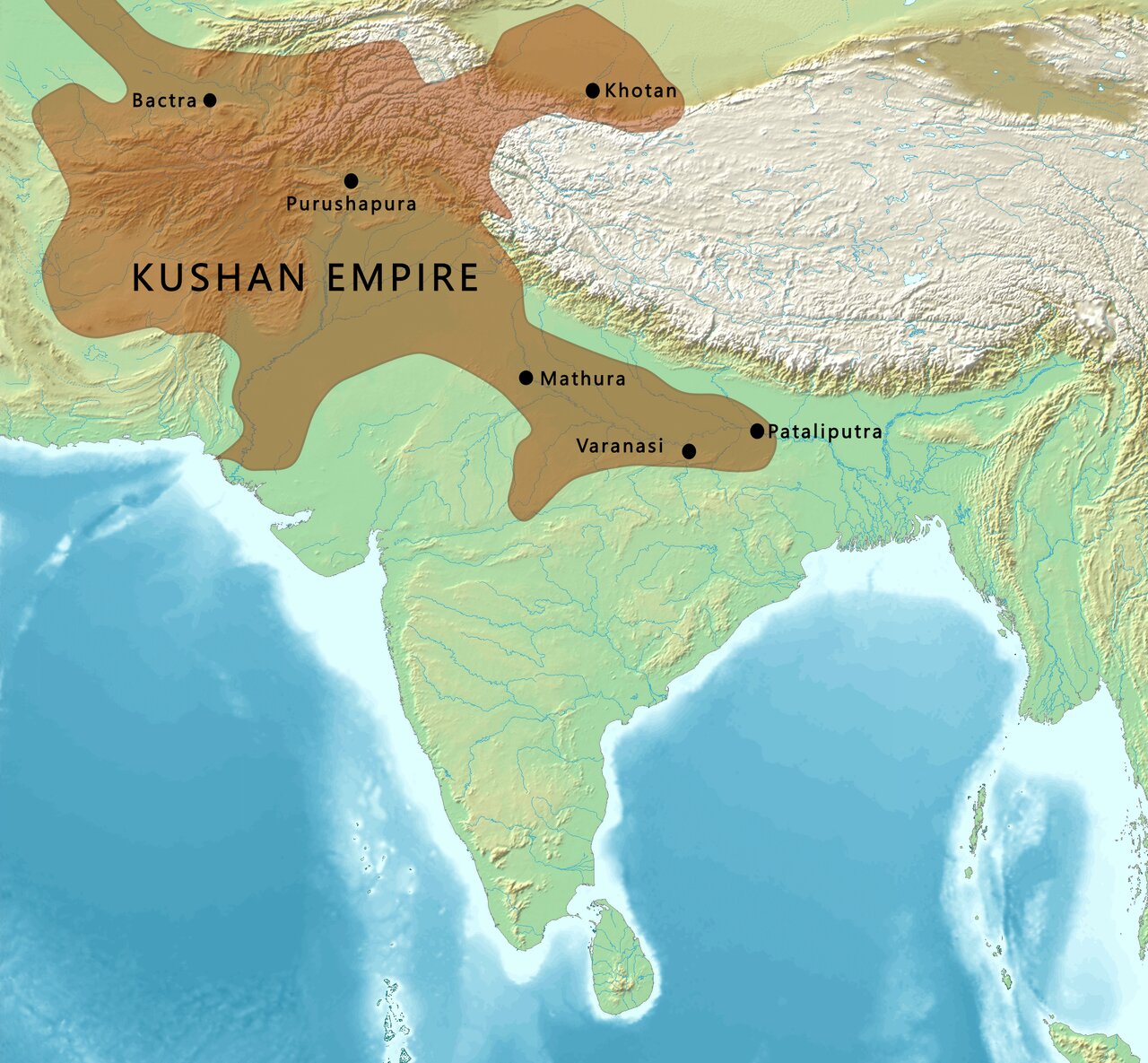
The Kushan Empire. The Kushan Empire (c. 30-375 CE) was built by the Yuezhi, a nomadic confederation driven west from the borders of China, who settled in Bactria and were united into an empire by Kujula Kadphises. His successors pressed south: Vima Takto and Vima Kadphises took the Indus region, and under Kanishka I the Kushans ruled a vast realm from the Central Asian steppe through Afghanistan to the Ganges plain, with capitals at Purushapura (Peshawar) and Mathura. Kanishka's accession (dated variously to 127, or more recently 127-151 CE by most scholars) marks the empire's peak.
The Kushans sat at the crossroads of the ancient world. Their territory straddled the Silk Road, and Roman gold, Indian ivory, Chinese silk and Central Asian horses all passed through their markets - Kushan gold coins imitated Roman weight standards. Their court was famously cosmopolitan: coins show Greek, Iranian, Indian and steppe gods labeled in Greek and Bactrian script, and Kanishka's era was used for centuries across South and Central Asia.
The Kushans' greatest cultural legacy is Buddhist. Kanishka is remembered in Buddhist tradition as a second Ashoka: he is credited with convening the Fourth Buddhist Council in Kashmir, and under Kushan patronage Buddhism spread along the trade routes into Central Asia and China. The Gandhara and Mathura schools of art flourished under them, producing the first human images of the Buddha and the giant statues of Bamiyan's artistic ancestors.
From the early 3rd century the empire declined: Ardashir I and the Sasanians took Bactria (making the western Kushans their vassal 'Kushanshahs'), while the Gupta kings absorbed the Indian provinces. Reduced to a rump in the Kabul valley, the last Kushans were finally overwhelmed by the Kidarite Huns around 375. But for three centuries they had linked China, India, Iran and Rome into one commercial and cultural world.
 Britannica: Kushan dynasty
 The Metropolitan Museum of Art: Kushan Empire (ca. Second Century B.C.-Third Century A.D.)
 Encyclopaedia Iranica: KUSHAN DYNASTY i. Dynastic History