 Go Back

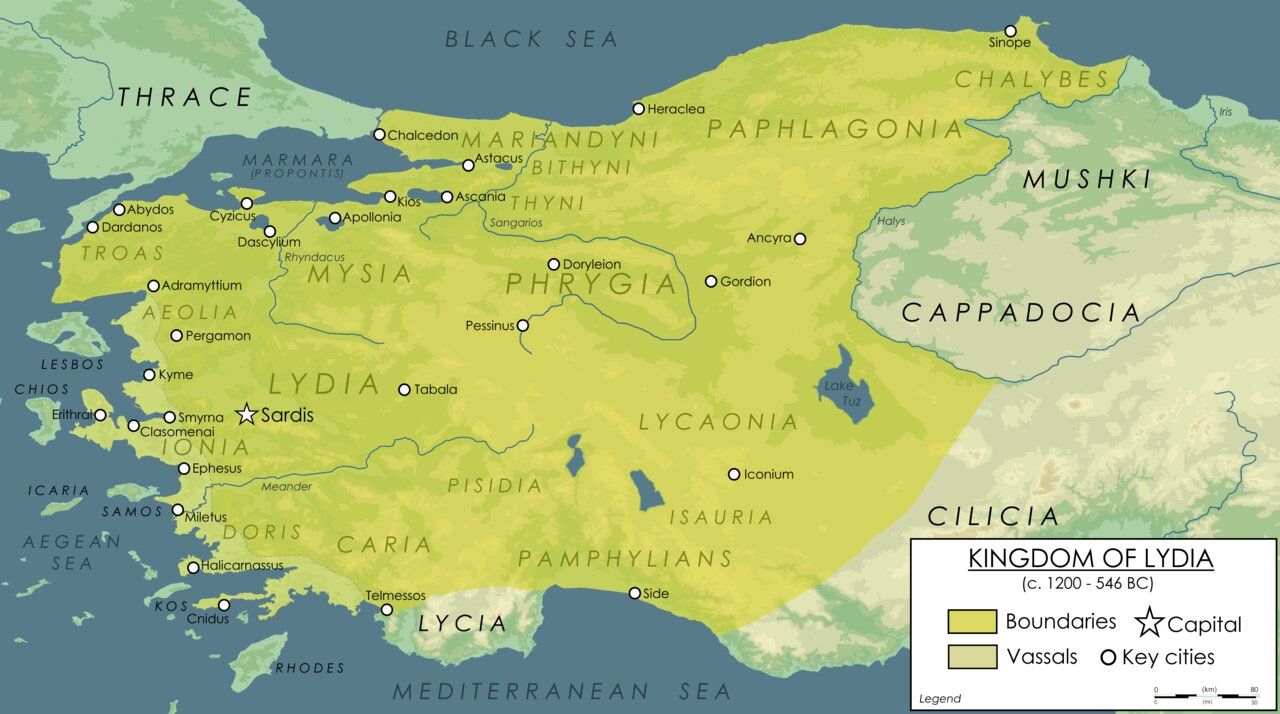
The Lydian and Phrygian Kingdoms. Phrygia and Lydia were the two great Iron Age kingdoms of western Anatolia, neighbors whose kings passed into Greek legend. The Phrygians, a people probably related to the Balkan Bryges, built their kingdom (c. 1200-700 BCE) on the ruins of the Hittite world with its capital at Gordium, where Midas - the historical King Mita of Assyrian records - ruled in the late 8th century and became the Greeks' golden-touch legend. Phrygian culture was distinctive: an early alphabet adapted from Phoenician, rock-cut monuments of the mountain mother goddess Matar (Cybele), and fine bronze and woodwork buried with their kings in huge tumulus tombs.
Phrygia was smashed around 695 BCE by Cimmerian raiders from the steppe, and its western lands passed to Lydia. The Lydians, an Anatolian people with their capital at Sardis, rose under the Mermnad dynasty: Gyges, who took the throne around 680 BCE and fought the Cimmerians; then Ardys, Sadyattes, Alyattes, who pushed Lydian power to the Halys River and fought the Medes to a standstill in the famous 'Battle of the Eclipse' (585 BCE); and finally Croesus, whose name became a byword for wealth.
Lydia's claim on history is money: the Lydians minted the world's first true coined currency, electrum and then pure gold and silver staters stamped with a royal lion, an invention that spread to Greece and Persia and changed trade forever. Croesus controlled the Greek cities of the Aegean coast and cultivated oracles across the Greek world, but in 546 BCE he misread Delphi's famous answer and marched on Cyrus the Great of Persia. Cyrus took Sardis, and Lydia became a Persian satrapy.
Both kingdoms left deep marks on the Greeks who told their stories: Phrygia gave Greek religion Cybele and music its 'Phrygian mode', while Lydia gave it coinage, the tragic tale of Croesus and Solon, and its first great cautionary tale about pride and fortune.
 World History Encyclopedia: Lydia
World History Encyclopedia: Phrygia
 The Metropolitan Museum of Art: Lydia and Phrygia