 Go Back

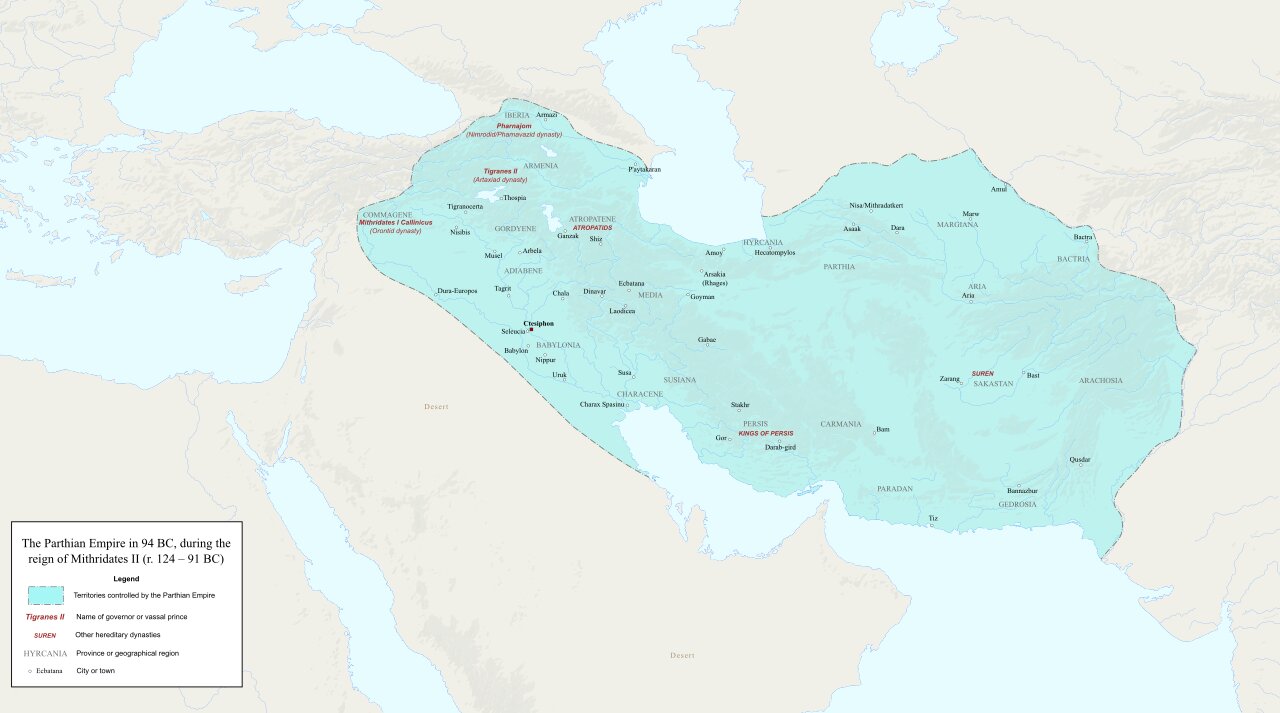
The Parthian Empire. The Parthian Empire (247 BCE-224 CE) was founded when Arsaces I, chief of the Parni nomads, seized the province of Parthia from the crumbling Seleucid Empire and made himself king. His dynasty, the Arsacids, spent a century consolidating the Iranian plateau before Mithridates I (r. 171-132 BCE) took Media, Babylonia and the great city of Seleucia in 141 BCE, making Parthia the heir to Persia and the master of the lands between the Euphrates and the Indus.
For nearly four centuries Parthia was Rome's equal and its only lasting rival. The Parthians' horse archers and armored cataphracts destroyed Crassus and his legions at Carrhae in 53 BCE - Rome's worst defeat in the east - and later saw off invasions by Mark Antony and several emperors, though Trajan and others did sack the capital Ctesiphon (opposite Seleucia on the Tigris) when Parthian politics turned chaotic. Between the two empires ran the Silk Road, and Parthian control of its western end made the empire rich on the China-Rome trade.
The empire was a loose, almost feudal structure: the 'King of Kings' ruled through powerful noble houses like the Suren and Karen, semi-independent vassal kingdoms, and Greek and Mesopotamian cities with their own privileges. Its culture mixed Iranian, Greek, Babylonian and steppe elements - Greek was used on early coins, Zoroastrianism grew stronger over time, and Parthian art developed its own distinctive front-facing style seen at Hatra and Dura-Europos.
Constant civil wars over the succession wore the Arsacids down. In 224 CE Ardashir I, a vassal king from Persis (Fars), defeated and killed the last Parthian king Artabanus IV at Hormozdgan and founded the Sasanian Empire. But the great Parthian families survived as pillars of the Sasanian aristocracy, and Parthia's four centuries had set the pattern of Iranian kingship that its successors inherited.
 Britannica: Arsacid dynasty
 World History Encyclopedia: Parthia (Empire)
 The Metropolitan Museum of Art: The Parthian Empire (247 B.C.-224 A.D.)
 Encyclopaedia Iranica: ARSACIDS