 Go Back

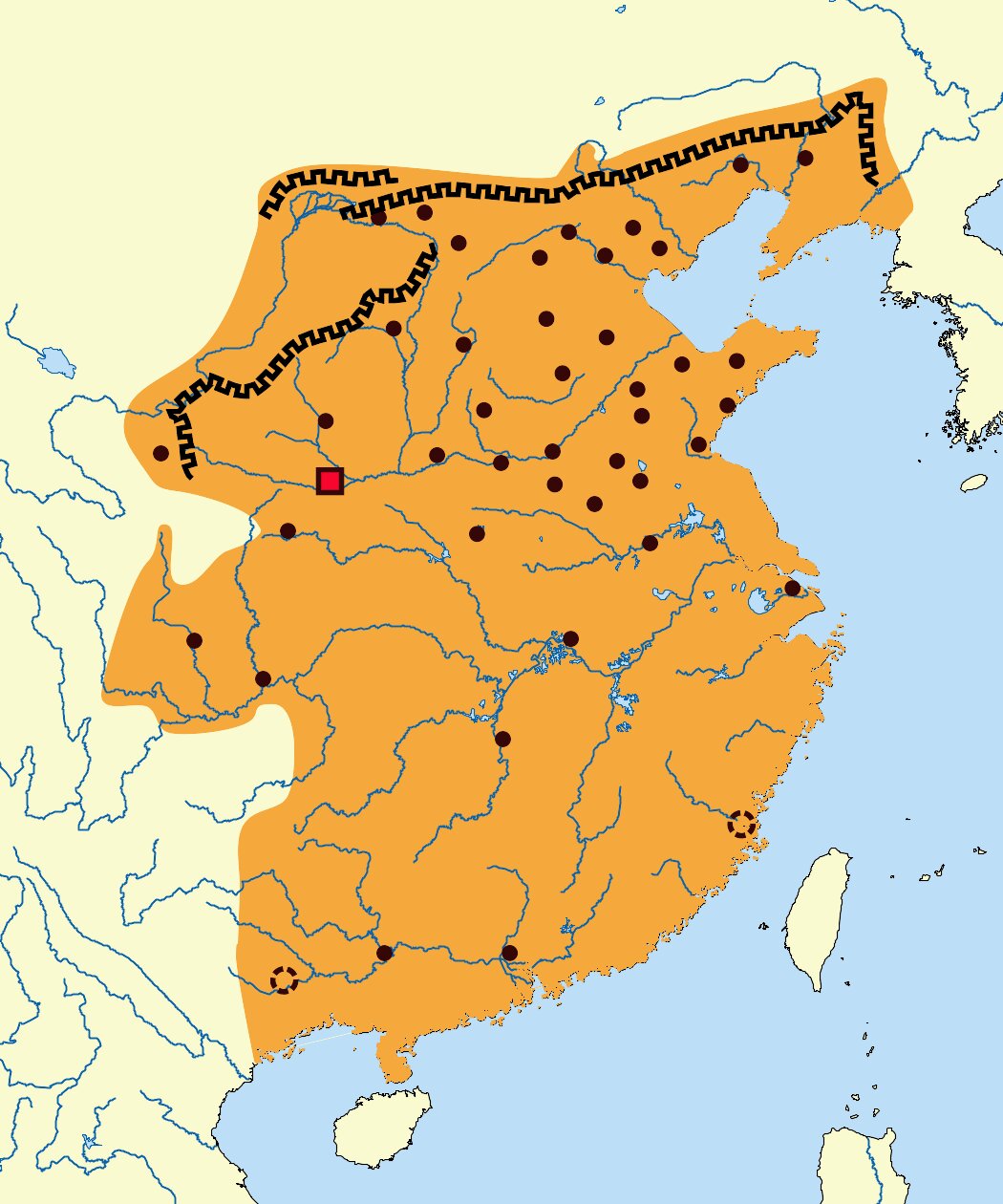
The Qin Dynasty. The Qin dynasty (221-206 BCE) lasted only fifteen years, but it created China. In 221 BCE Ying Zheng, king of the western state of Qin, completed the conquest of his six rivals and took a new title - Qin Shi Huang, First August Emperor of Qin - ruling the first unified empire in Chinese history. Guided by his chancellor Li Si and Legalist doctrine, he abolished the old feudal states and divided the empire into thirty-six commanderies governed by appointed officials.
The First Emperor standardized a civilization. One script, one currency, one set of weights and measures, one axle width for carts were imposed across the empire; great roads radiated from the capital Xianyang; and hundreds of thousands of laborers joined the old northern walls into the first Great Wall against the steppe, while armies pushed south to the coasts of Guangdong. His suspicion of criticism produced the infamous 'burning of the books' (213 BCE) and the burying of scholars - though practical and court texts were preserved.
His megalomania built his own tomb: an underground palace-city east of Xianyang guarded by the Terracotta Army, some eight thousand life-size soldier statues discovered by farmers in 1974, now among the most famous archaeological finds on earth. When the First Emperor died in 210 BCE, a palace conspiracy put his weak younger son on the throne; within a year the empire exploded in peasant and aristocratic revolts (209 BCE), and by 206 the Qin was destroyed.
Yet the Qin did not really fail: the Han dynasty that replaced it kept almost its entire system - centralized bureaucracy, commanderies, standardized law and script - for four centuries, and every Chinese empire since has been built on the Qin template. Even China's English name comes from 'Qin'.
 Britannica: Qin dynasty
 The Metropolitan Museum of Art: Qin Dynasty (221-206 B.C.)
 Humanities LibreTexts: 5.4: The Qin Dynasty