 Go Back

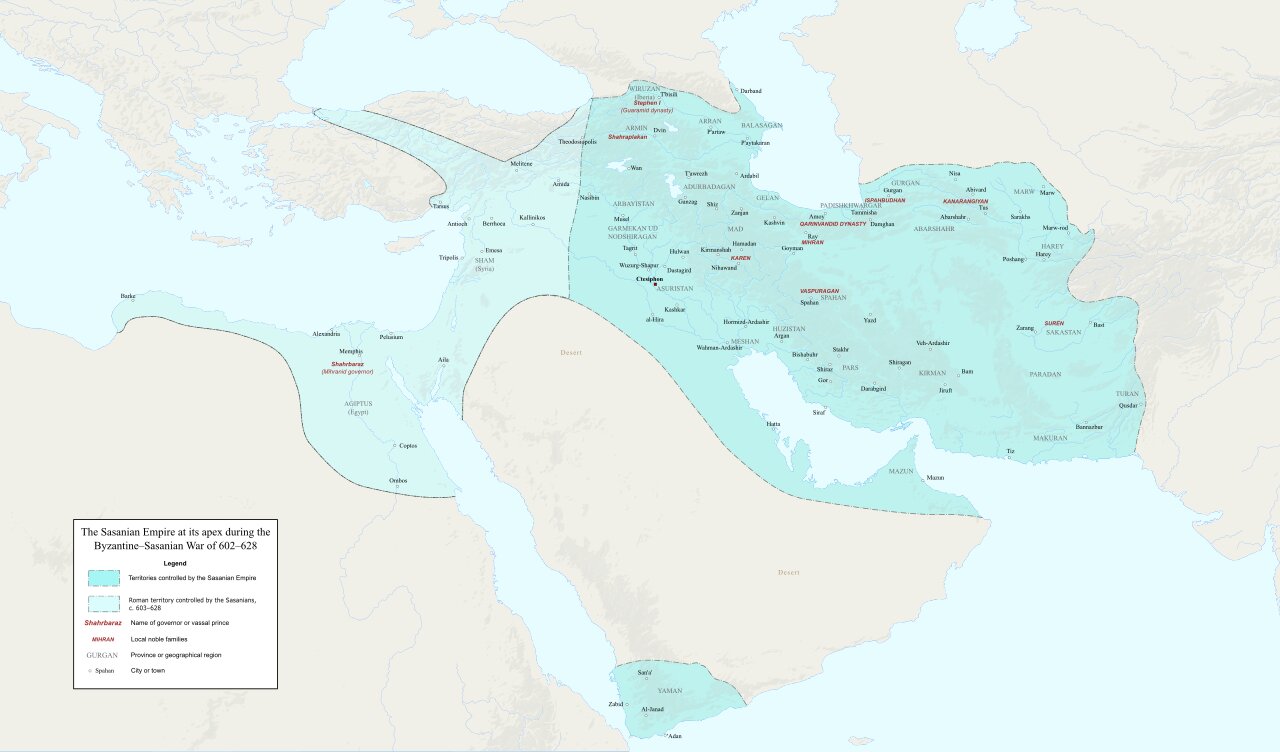
The Sasanian Empire. The Sasanian Empire (224-651 CE) was the last and most glorious of the pre-Islamic Iranian empires. It was founded by Ardashir I, a king of Persis who overthrew his Parthian overlord in 224 and rebuilt Iranian kingship around his dynasty, Zoroastrian orthodoxy, and a centralized administration. His son Shapur I made the young empire a superpower: in 260 he defeated the Romans at Edessa and captured the emperor Valerian alive - a humiliation carved on the royal rock reliefs of Naqsh-e Rustam - and pushed Persian arms to the Mediterranean.
For four centuries the Sasanians were Rome's and then Byzantium's great rival. Wars over Armenia, Mesopotamia and the trade routes see-sawed for generations, punctuated by long peace treaties. At home the kings built cities, canals and fire temples; Zoroastrianism became a state church, while Manichaeism appeared and was suppressed and Christian, Jewish and Buddhist communities lived under varying tolerance. The reign of Khosrow I Anushirvan ('of the immortal soul', r. 531-579) was the empire's golden age: tax and military reforms, the academy of Gondishapur where Greek, Persian, Syrian and Indian learning met, and a reputation for justice that made him a model king in later Islamic literature.
Khosrow II (r. 590-628) gambled on total victory: his armies took Jerusalem (614), Egypt (619) and camped opposite Constantinople, but the emperor Heraclius struck back, shattered the Persian army at Nineveh (627), and the empire collapsed into palace coups - eight rulers in four years. Exhausted and divided, the Sasanians could not withstand the armies of the Muslim conquest: Qadisiyya (636) and Nahavand (642) decided the war, and the last king, Yazdegerd III, was killed at Merv in 651.
The Sasanian legacy was enormous. Its court ceremony, titles, silver, textiles and art were copied from Byzantium to China; its scholars preserved Greek and Indian science for the Islamic world; and its model of centralized, cosmopolitan kingship became the template the Abbasid caliphs followed in Iraq.
 Britannica: Sasanian dynasty
 World History Encyclopedia: Sasanian Empire
 The Metropolitan Museum of Art: The Sasanian Empire (224-651 A.D.)
 Encyclopaedia Iranica: SASANIAN DYNASTY