 Go Back

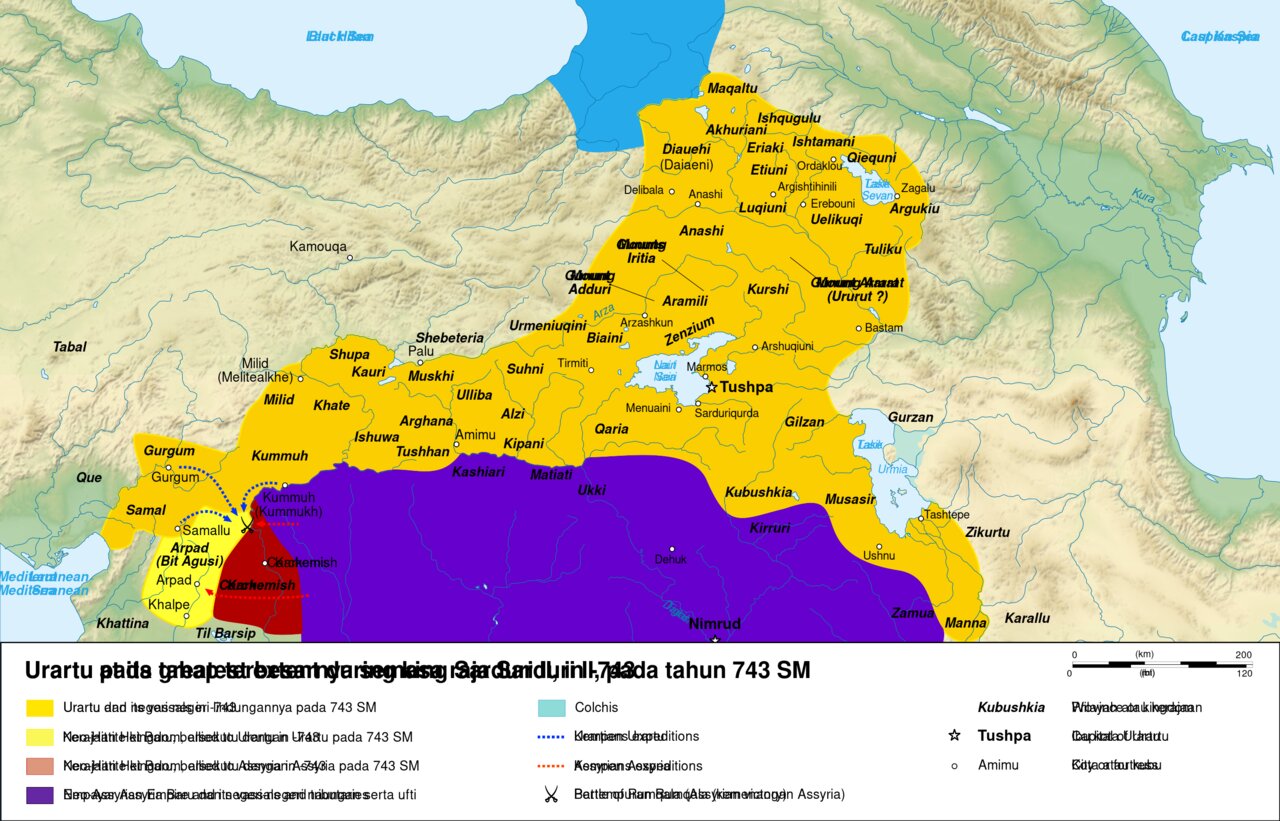
The Kingdom of Urartu. Urartu (c. 860-590 BCE), the biblical Ararat, was a powerful Iron Age kingdom centered on Lake Van in the mountainous highlands of eastern Anatolia, with lands reaching into modern Armenia and northwest Iran. Welded together from local tribes by King Sarduri I around 832 BCE, with its fortress capital at Tushpa (Van), it spent two and a half centuries as the northern rival of Assyria - the one neighbor the Assyrian kings could never permanently defeat.
Urartu's kings, above all Menua and Argishti I, turned a harsh mountain land into an organized state. They built sophisticated irrigation works - the Menua Canal, still in use, carried water nearly 70 kilometers - terraced vineyards, and chains of spectacular hilltop fortresses like Erebuni (782 BCE, the nucleus of modern Yerevan) and Teishebaini. Urartian bronzesmiths and metalworkers produced armor, cauldrons and furniture traded across the Near East, and the royal chancery kept records in a cuneiform script of its own. Royal inscriptions boasted of building 'a marvel' wherever the kings campaigned, and archaeology has confirmed the boast.
The kingdom's fate was tied to Assyria's. When Assyria was weak, Urartu expanded, even dictating terms to the states of northern Syria; when Sargon II marched north in 714 BCE and looted the holy city of Musasir, Urartu's confidence cracked. Pressure from Cimmerian and Scythian raiders from the steppe weakened it further, and after Assyria itself collapsed, the Medes overran the Urartian heartland around 590 BCE, burning its fortresses.
Urartu vanished so completely that its memory survived mainly in Assyrian records and the Bible's 'mountains of Ararat', until 19th-century scholars deciphered its inscriptions. Its direct heir was Armenia: the Urartian language and people contributed heavily to the Armenian highland population, and the name of Yerevan descends from the Urartian fortress of Erebuni.
 Britannica: Urartu
 World History Encyclopedia: Urartu Civilization
 The Metropolitan Museum of Art: Urartu
 Encyclopaedia Iranica: URARTU IN IRAN