 Go Back

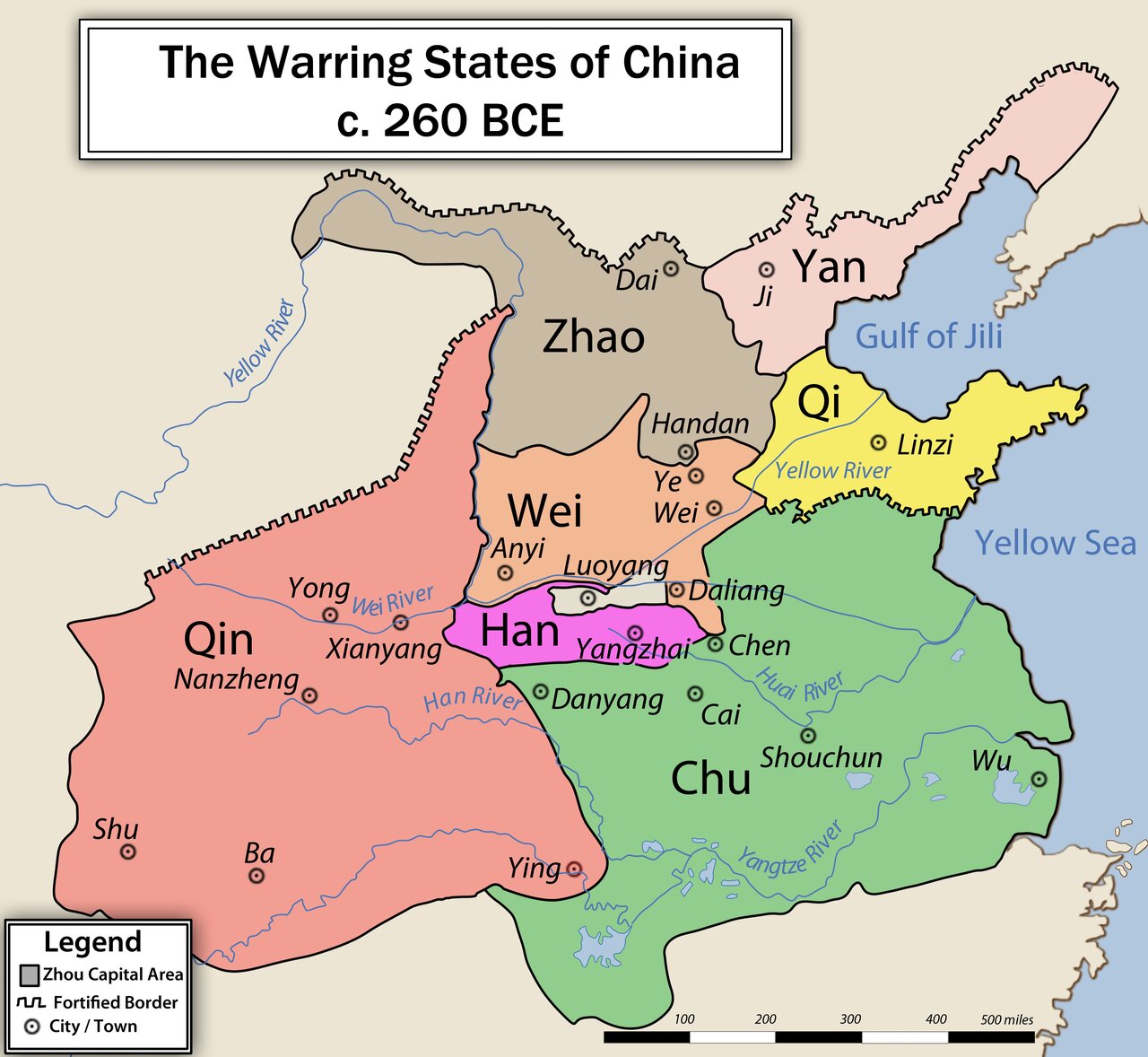
The Warring States Period. The Warring States period (475-221 BCE) was the age of total war that ended ancient China's Zhou order and forged its first empire. As the Zhou kings lost all real power, their former vassal states devoured each other; after the partition of the great state of Jin in 403 BCE, seven major powers - Qin, Chu, Qi, Yan, Han, Zhao and Wei - fought for supremacy across the Chinese world for over two centuries.
Warfare was transformed. Small aristocratic chariot armies gave way to mass infantry levies numbering in the hundreds of thousands, armed with iron weapons and the deadly crossbow, while the northern states learned cavalry from the steppe nomads. Victory went to the states that reformed most ruthlessly: Shang Yang's Legalist reforms in Qin (from 356 BCE) replaced hereditary privilege with military merit, strict law, and registration of the whole population, turning Qin into the most efficient war machine of the age.
The same violent century was China's greatest age of thought - the Hundred Schools of Philosophy. Confucians like Mencius and Xunzi, Daoists like Zhuangzi, the Legalists Han Fei and Li Si, Mohists, logicians and strategists all debated how to restore order, and their answers became the permanent furniture of Chinese civilization. Diplomacy ('vertical and horizontal' alliances), trade, city growth and iron-fueled agriculture flourished even as the battles - like Changping in 260 BCE, where Qin buried alive tens of thousands of Zhao prisoners - grew ever more terrible.
The end came fast: Qin's king Ying Zheng destroyed Han (230), Zhao (228), Wei (225), Chu (223), Yan (222) and finally Qi (221), uniting China and proclaiming himself First Emperor. The Warring States period had created the centralized bureaucratic empire - and the philosophical traditions - that would define China for two thousand years.
 Britannica: Warring States
 World History Encyclopedia: Warring States Period
 Humanities LibreTexts: 4.3: Eastern Zhou (771 BCE - 400 BCE)