 Go Back

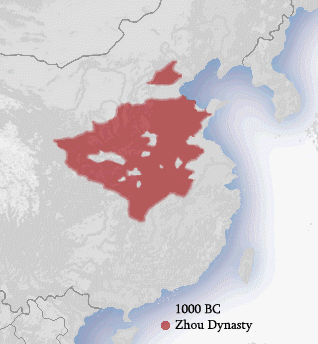
Zhou Dynasty. The Zhou dynasty (c. 1046-256 BCE) ruled China longer than any dynasty before or since - nearly eight centuries - and though its kings wielded real power for less than a third of that span, the age they presided over created Chinese philosophy, Chinese political theory, and much of the classical canon. The Zhou began as a frontier people of the Wei River valley, culturally close to their Shang overlords, until King Wen built their strength and his son King Wu led the coalition that shattered the Shang at Muye around 1046 BCE.
To rule the vast eastern plain, the early Zhou devised two instruments that defined China for millennia. The fengjian system parceled the realm into domains granted to royal kinsmen and allies - a feudal network binding far-flung colonies to the throne. And the doctrine of the Mandate of Heaven explained why the Zhou, not the Shang, deserved to rule: heaven grants kingship to the virtuous and withdraws it from the corrupt, so conquest itself was proof of heaven's will. The Duke of Zhou, regent for the young King Cheng, crushed a great rebellion of the old Shang heartland and became Confucius's model of the virtuous statesman.
Royal power lasted until 771 BCE, when nomadic Quanrong tribes sacked the capital Haojing and killed King You; the court fled east to Luoyang, and the 'Eastern Zhou' that followed was kingship in name only. The Spring and Autumn period (771-c. 481 BCE) saw dozens of states maneuver under a ceremonial Zhou king; the Warring States period (c. 475-221 BCE) that followed was total war - mass infantry armies, iron weapons, cavalry, and ruthless administrative reform - as the great states swallowed the small until only seven remained. Qin deposed the last Zhou king in 256 BCE and unified China by 221 BCE.
Paradoxically, this age of collapse was China's greatest age of thought. As rival lords competed for talent, the 'Hundred Schools of Thought' flourished: Confucius taught a system of mutual duty and humane governance, Laozi and the Daoists counseled harmony with the natural Way, the Legalists demanded strict law and harsh punishment, Mozi preached universal care, and Sun Tzu codified the art of war. Chinese philosophy, statecraft, and ethics would live in the world the dying Zhou made for the next two thousand years.
 Britannica: Zhou dynasty
 World History Encyclopedia: Zhou Dynasty
 Humanities LibreTexts: 2: The Zhou Period (1045 – 256 BC)
 Smithsonian Institution: Zhou dynasty (ca. 1050–221 BCE)