 Go Back

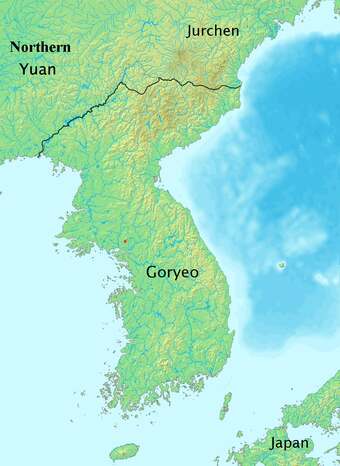
The Goryeo Kingdom. Goryeo (918-1392) was the kingdom that gave Korea its name - the state that unified the peninsula and welded the old identities of Goguryeo, Baekje, and Silla into a single Korean nation. It was founded in 918 by the general Wang Kon, known as Taejo, during the chaos of the Later Three Kingdoms; by 936 he had peacefully absorbed Silla, conquered Later Baekje, and welcomed the fleeing ruling class of Balhae - achieving what Korean historians call the first true national unification. From his capital at Gaegyeong (modern Kaesong), his dynasty ruled for nearly five centuries.
Goryeo's golden age, lasting into the early 12th century, was one of the brilliant civilizations of East Asia. Buddhism, the state religion, reached its highest influence in Korean history - the capital alone held 70 temples. Goryeo's merchants traded with Song China and even Arabia; its celadon pottery, perfected with the inlaid sanggam technique, was praised in China itself; and its reverence for learning produced the Tripitaka Koreana, the complete Buddhist canon carved on 81,258 wooden printing blocks - still preserved at Haeinsa temple and called by UNESCO one of the most important collections of Buddhist texts in the world. In the early 13th century, Goryeo craftsmen were printing books with movable metal type - two centuries before Gutenberg.
The kingdom's later centuries were harder. From 1170 military dictators ruled behind the throne, and from 1231 came the Mongol invasions: Goryeo resisted for nearly 30 years from its island refuge on Ganghwa before suing for peace in 1259 and becoming a 'son-in-law state' of the Yuan dynasty (1270-1356). Yet even in vassalage the kingdom endured and recovered its independence as Mongol power waned.
The end came in 1392, when the general Yi Seonggye - sent to invade Ming China in 1388 - turned his army around at the border, seized the throne, and founded the Joseon dynasty that would rule Korea into the modern age. But Goryeo's legacy is Korea itself: the nation's name, its unified identity, its celadon, its Buddhist canon, and a printing tradition that led the world.
 Britannica: Goryeo dynasty
 World History Encyclopedia: Goryeo
 Humanities LibreTexts: 8.6: Goryeo Dynasty (918 CE and 1392 CE)
 Smarthistory: Goryeo dynasty