 Go Back

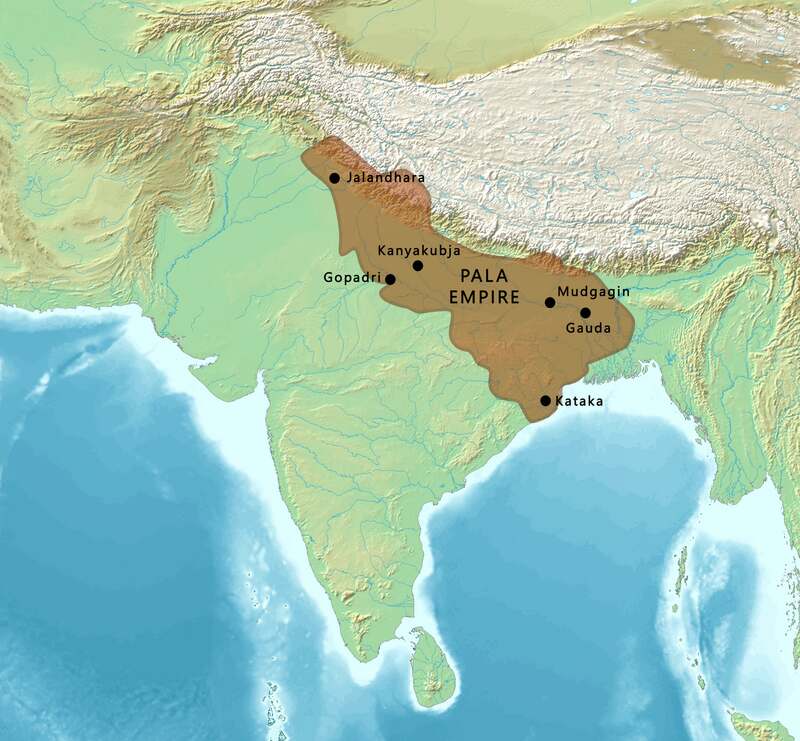
Pala Empire. The Pala Empire (750-1161) was the last great Buddhist imperial power in India - and one of history's more unusual origin stories. When Gopala was elected king by the chiefs of Gauda in the mid-8th century, he was, as an Arabic source puts it, 'not a king of noble origin'; Bengal had endured generations of anarchy, and the regional chiefs chose a ruler to end it. From that improvised beginning, the Palas built an empire covering Bengal and Bihar that, at its early-9th-century zenith under Dharmapala and Devapala, dominated northern India from the Gangetic Plain to the Vindhya Range.
The Palas fought and negotiated their way through the great 'tripartite struggle' for Kannauj against the Gurjara-Pratiharas and the Rashtrakutas, fielding a famous corps of war elephants and a navy that worked the Bay of Bengal. But their deepest power was cultural. Devout Buddhists ruling a largely Hindu population - their inscriptions and images show generous patronage of Shiva and Vishnu too - they made their court the stronghold of late Indian Buddhism: they raised the great monasteries of Somapura Mahavihara and Odantapuri and patronized the universities of Nalanda and Vikramashila, then at their world-famous height.
Pala influence traveled with its monks and merchants. The scholar Atisa Dipankara carried Bengal's Buddhism to Tibet, where the Pala legacy still shapes Tibetan Buddhism today; the empire maintained relations with Srivijaya in Indonesia, with Tibet, and with the Abbasid Caliphate - contacts along which Islam first reached Bengal. At home the Pala centuries were a golden age of Bengali art: the sculpture, bronzes, and manuscript paintings of Pala workshops, and the Charyapada songs of its tantric Buddhist poets, among the earliest texts in the eastern Indian languages.
The empire's later centuries were a long defense: Mahipala I fought off the Chola invasions from the south, and Ramapala, the last strong Pala emperor, briefly revived its power. But the Varendra rebellion of the 11th century exposed how dependent the Palas had become on their feudatories, and in the 12th century the Hindu Sena dynasty drove them from Bengal itself. When the last Pala, Govindapala, disappears from record in 1161, the age of Buddhist imperial power in India ended with him.
 Britannica: Pala dynasty
 World History Encyclopedia: The Rashtrakuta, Gurjara-Pratihara and Pala Empires, Ancient India
 Humanities LibreTexts: 7.2: Early Medieval Empires of India (550 CE – 1200 CE)
 Smarthistory: Pala Empire