 Go Back

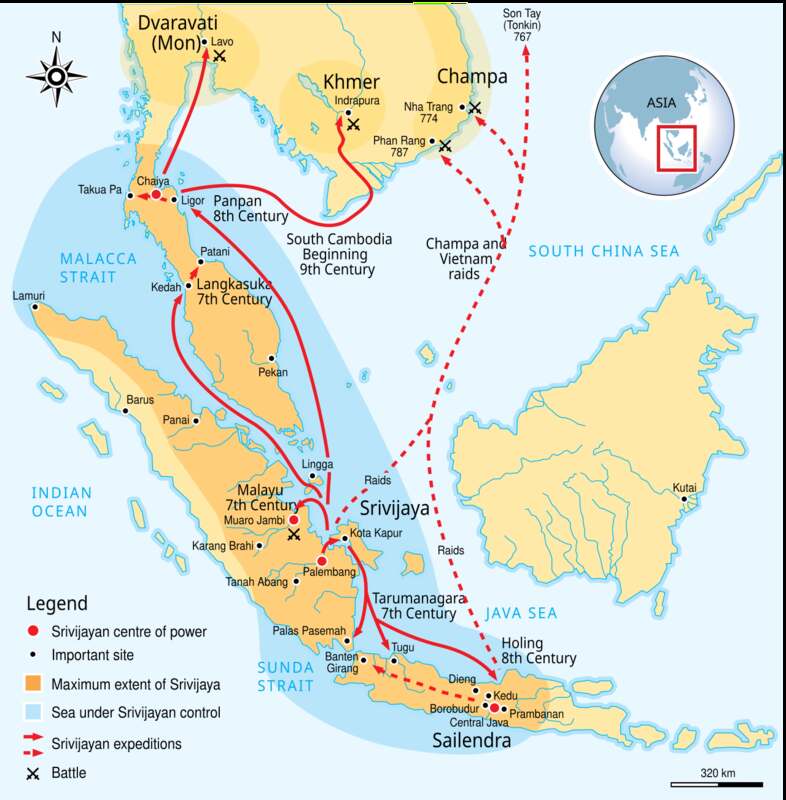
The Srivijaya Empire. Srivijaya (c. 671-1025) was the first great power of maritime Southeast Asia - a Malay Buddhist empire based at Palembang on Sumatra that for three and a half centuries dominated the western archipelago and the straits through which all trade between India and China had to pass. Its wealth was the wealth of the sea lanes: a prestige-goods economy built on controlling, taxing, and protecting the booming commerce of the region, with trade agreements nurtured with China from the Tang to the Song dynasty.
Srivijaya was also a holy land of Buddhism. When the Chinese monk Yijing stopped at Palembang in 671, he found a thriving center of Buddhist learning where monks prepared for the journey to India; for four centuries the empire was one of the great centers for the expansion of Buddhism, maintaining religious and cultural links with the Pala kingdom of Bengal and even with the Islamic Caliphate. Its oldest voice survives in stone: the Kedukan Bukit inscription of 682, found near Palembang, records the king's sacred journey to found the empire's fortune.
Historians once pictured Srivijaya as a pure thalassocracy ruling through its fleets; newer research sees a land-based kingdom whose navy existed to project land power and coerce trading ships into its ports. Either way, the straits were its lifeline - and when that lifeline was cut, the empire died. In 1025 the Chola Empire of south India, Srivijaya's great commercial rival, launched devastating raids on its ports across the straits. The kingdom may never have recovered: though Chinese sources kept naming a 'Sanfoqi' in the region, the center of power had passed, and the age of Srivijaya was over.
So complete was its fall that Srivijaya was simply forgotten - even in Palembang itself, no one remembered the empire until the French scholar George Coedes resurrected it from Chinese records and Old Malay inscriptions in 1918. Today it stands revealed as the missing first chapter of Indonesian history: the first polity to dominate western maritime Southeast Asia, and the proof that the archipelago's seas could carry an empire.
 Britannica: Srivijaya empire
 Humanities LibreTexts: 12.3: East-West Interactions in the Early Middle Ages
 UNESCO Digital Library: The Art of Srivijaya
 Smithsonian Institution: Rare and Strange Goods: International Trade in Ninth-Century Asia