 Go Back

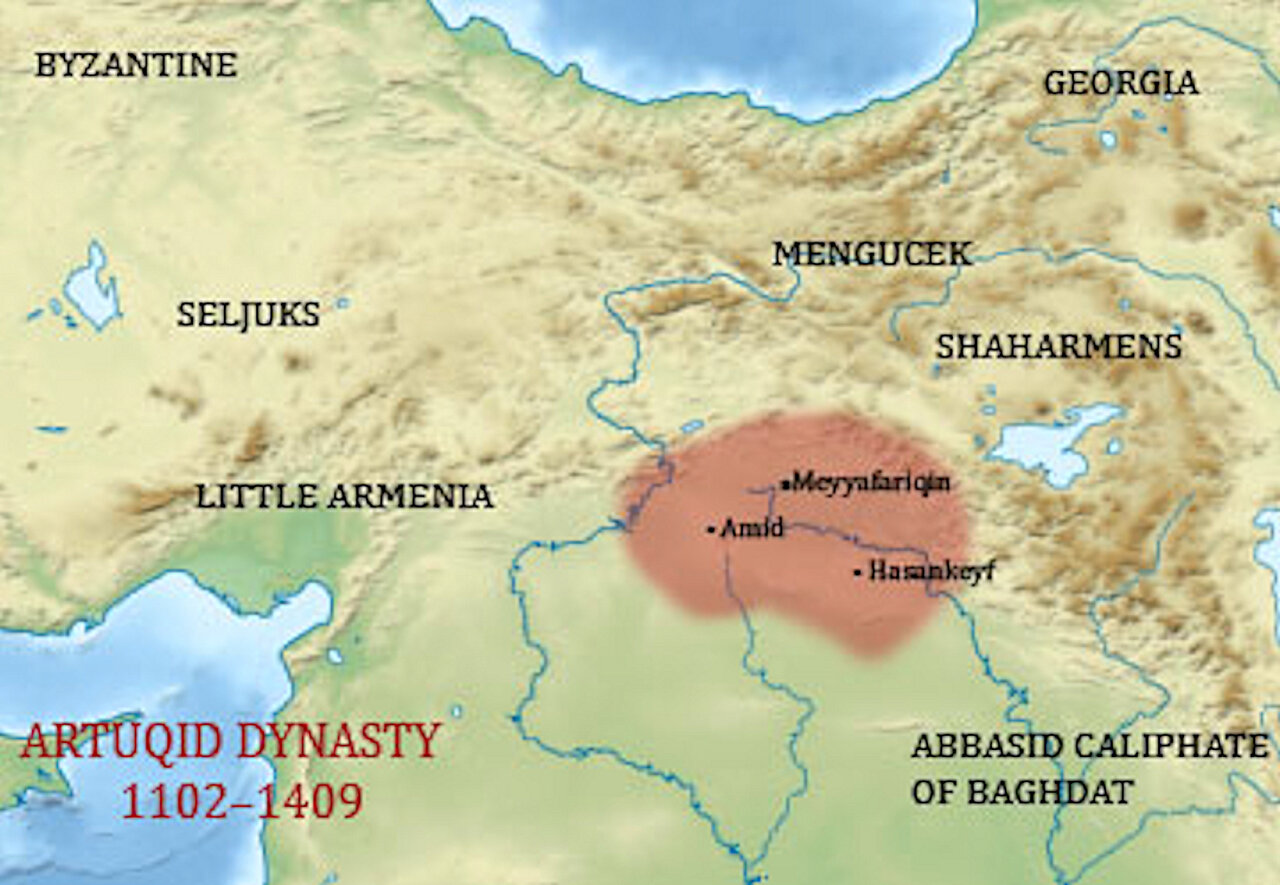
The Artuqids. The Artuqids (1102-1409) were a Turkmen dynasty of the Anatolian frontier, founded by Artuk, a Seljuk commander rewarded with Palestine - which he promptly lost to the Crusaders. His sons and nephews did better, carving out three branches in the Diyarbakir region (Diyar Bakr) of southeastern Anatolia and the Jazira: Mardin, Hasankeyf (Amid), and Harput, which they ruled as the region's durable middle power for three centuries.
Wedged between the Seljuks of Rum, the Crusader states, the Zengids, and later the Ayyubids and Mongols, the Artuqids survived by balancing: they allied with or submitted to each stronger neighbor in turn, fought for and against the Crusaders, and served as atabegs and vassals of Zengi, Saladin and the Ilkhanate in turn. Their cities - Mardin on its citadel rock, Hasankeyf on the Tigris, Diyarbakir with its black basalt walls - changed hands with them but prospered as trade and craft centers.
The Artuqids' real glory is their art and architecture, among the finest of the Turkish Middle Ages: the Great Mosques of Mardin and Diyarbakir, palace carvings, and above all their figural metalwork - astonishing inlaid bronze ewers, mirrors and door fittings with courtly and astrological scenes (one carries the earliest known depiction of a Mongol court) - and their illustrated manuscripts, including copies of al-Jazari's Book of Ingenious Devices with its famous automata.
After Mongol overlordship the branches declined: Hasankeyf fell to the Ayyubids in 1232, Harput ended in 1334, and the Mardin line lingered as vassals until the Qara Qoyunlu Turkmen took the city in 1409. Their carved stone, metalwork and bridges - like the Malabadi Bridge - still define the landscape of southeastern Turkey.
 Britannica: Artuqid Dynasty
 The Metropolitan Museum of Art: The Art of the Seljuq Period in Anatolia (1081-1307)
The Metropolitan Museum of Art: Court and Cosmos: The Great Age of the Seljuqs