 Go Back

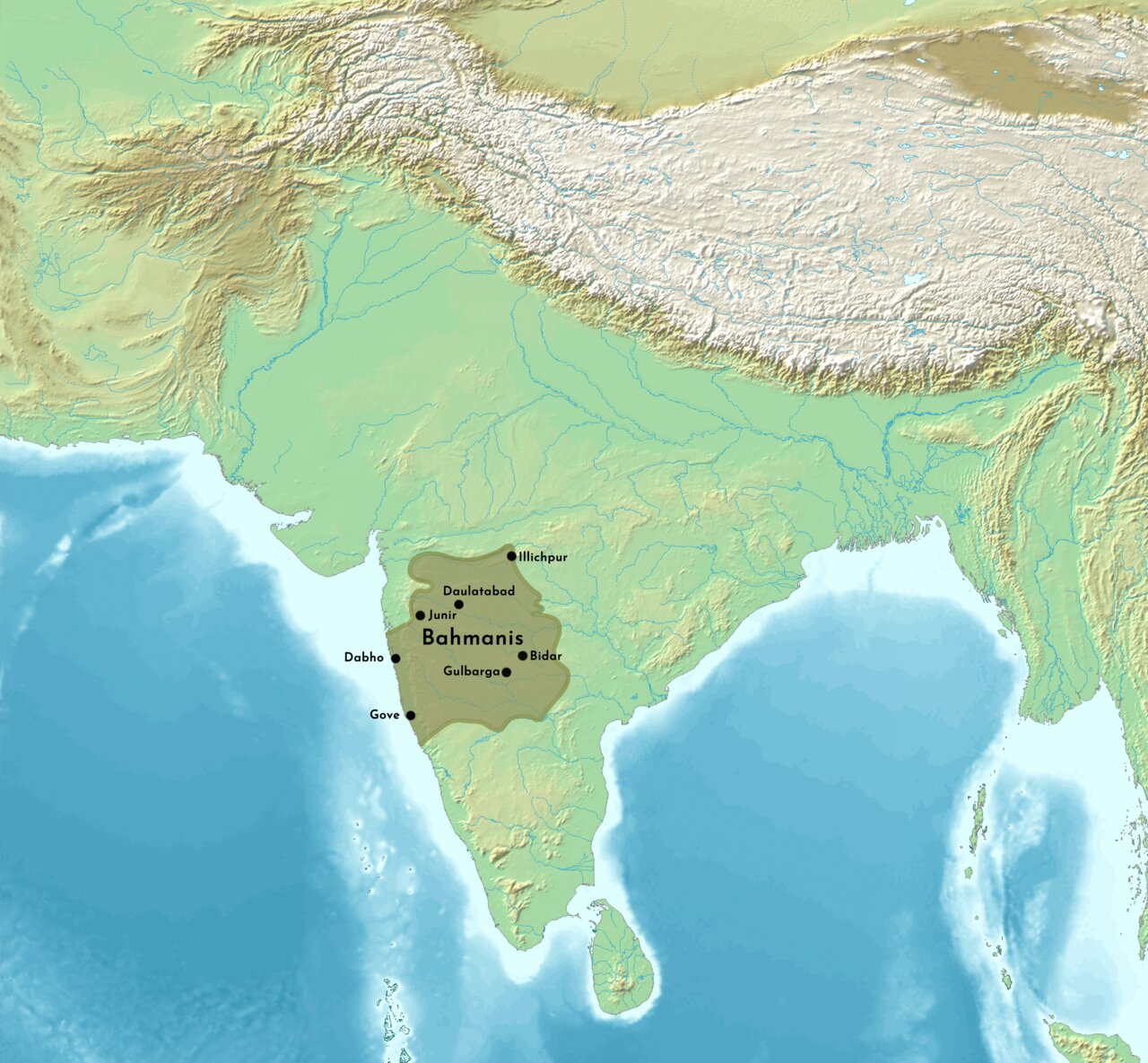
The Bahmani Sultanate. The Bahmani Sultanate (1347-1518) was the first great Muslim kingdom of the Deccan, founded when Ala al-Din Hasan Bahman Shah, an officer of the Delhi Sultanate, led the Deccan's Muslim amirs in revolt against Muhammad bin Tughluq and made himself sultan at Gulbarga. For nearly two centuries the Bahmanis were the dominant power of peninsular India, locked in a famous long duel with the Hindu empire of Vijayanagara to their south.
The sultanate's wars with Vijayanagara - over the rich Raichur Doab between the Krishna and Tungabhadra rivers - were among the most savage of the age, with both sides massacring prisoners and both adopting gunpowder weapons early; the Bahmanis fielded some of India's first effective artillery. Internally the kingdom was split between the 'Deccani' old Muslim families and the 'Afaqis', newcomers from Iran and Central Asia, whose rivalry - and the over-mighty ministers it produced - ran like a fault line through Bahmani politics.
The sultanate's greatest minister, Mahmud Gawan (r. 1461-1481), built the finest madrasa of the Deccan at Bidar (the new capital after 1422), extended the kingdom from sea to sea, and corresponded with the rulers of Iran - until the Deccani faction destroyed him. His murder in 1481 broke the state's cohesion, and after 1490 the provincial governors of Berar, Bidar, Ahmadnagar, Bijapur and Golconda set up as the five Deccan successor sultanates.
The Bahmanis left the Deccan permanently transformed: Persian culture, gunpowder warfare, and the Indo-Islamic architecture of Gulbarga and Bidar - whose later monuments, like the madrasa of Mahmud Gawan, remain among India's finest - passed to the successor states, of which Bijapur and Golconda would outshine the parent kingdom until the Mughals came.
 Encyclopaedia Iranica: Bahmanid Dynasty
 The Metropolitan Museum of Art: Islamic Art of the Deccan
Encyclopaedia Iranica: Deccan: Political and Literary History