 Go Back

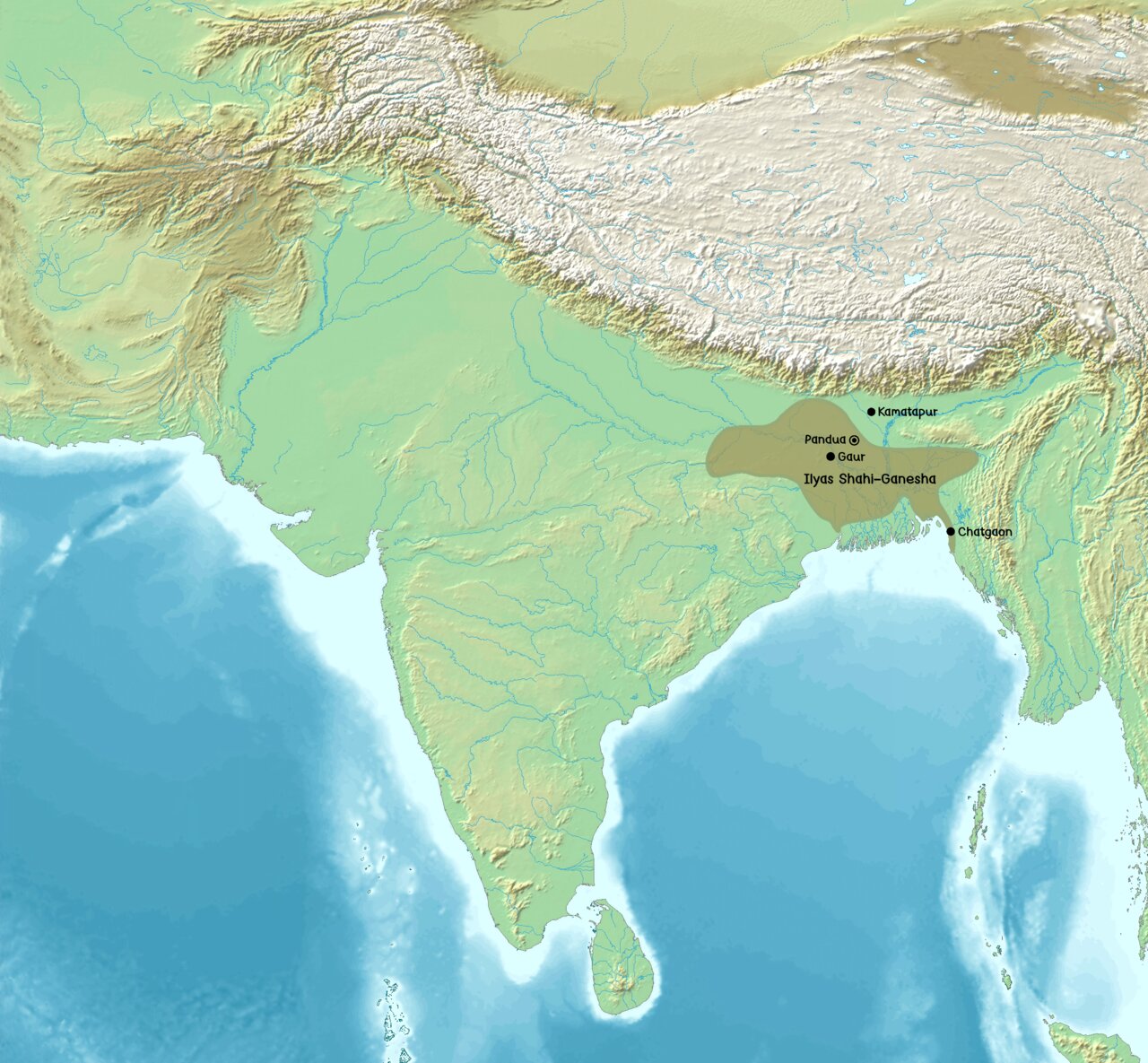
The Bengal Sultanate. The Bengal Sultanate (1342-1576) ruled the wealthy delta of Bengal for two centuries as an independent Muslim kingdom. Bengal had been conquered in 1204 by the Ghurid general Bakhtiyar Khalji and governed from Delhi, but in 1342 the governor Shams al-Din Ilyas Shah broke away, unified the delta, and founded a dynasty whose successors - with one famous interruption - made Bengal one of the richest and most cosmopolitan states of the Indian Ocean.
The interruption was extraordinary: Raja Ganesha, a Hindu zamindar of Dinajpur, seized effective power (1414-1418) and set his own son on the throne as the Muslim sultan Jalal al-Din Muhammad Shah - a Bengali convert under whom the sultanate took its distinctive syncretic form: Muslim kingship, Persian court culture, and deep patronage of the Bengali language. Under the restored Ilyas Shahi and then the Hussain Shahi dynasty (1494-1538) - whose founder, the Arab Alauddin Husain Shah, presided over Bengal's golden age - Bengali literature flowered with state support: the first great Bengali epics and Vaishnava poetry, and the building of Bengal's distinctive curved-eave mosques like the Sixty Dome Mosque of Bagerhat (a UNESCO site) and the great cities of Gaur and Pandua.
Bengal's wealth was legendary: the delta's rice fed its dense population, and its muslins and silks, sugar and ships drew merchants from Malacca to Hormuz; the Portuguese established themselves at Chittagong and Hugli in the 16th century. The sultanate's coins circulated as far as Malacca, and its diplomatic correspondence ranged from the Mamluks to Ming China.
Weakened by the Afghan (Suri) conquest of North India and by Arakanese and Portuguese pressure, the last sultans fell to the Mughals: Akbar's generals took Gaur, and after the defeat and death of Daud Khan Karrani (1576) Bengal became a Mughal province - the empire's richest, still remembered in Bengal as the end of its independent age.
 Encyclopaedia Iranica: Persian Muslim Elements in the History of Bengal
Encyclopaedia Iranica: Bengal
 The Metropolitan Museum of Art: Islamic Art of the Deccan