 Go Back

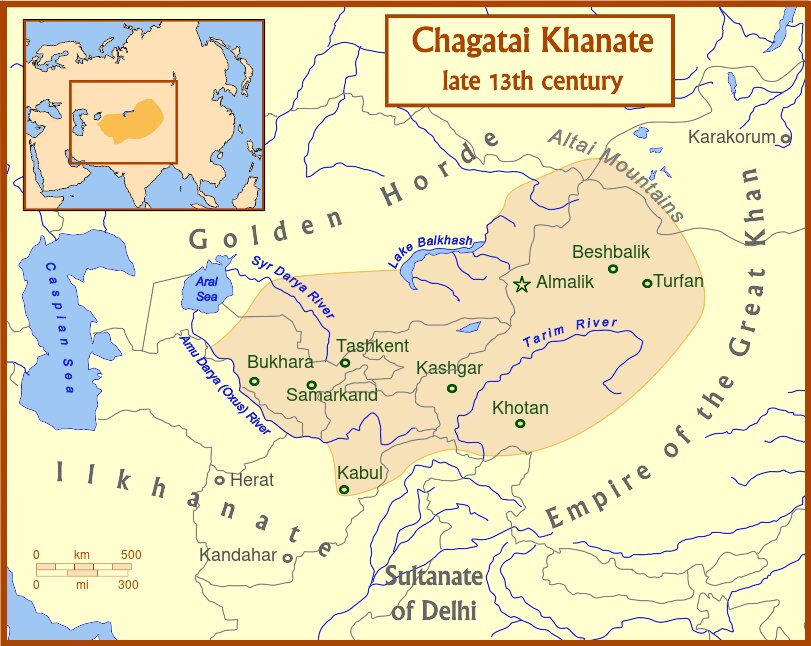
The Chagatai Khanate. The Chagatai Khanate (1227-1363) was the Central Asian quarter of the Mongol Empire, the ulus (appanage) of Chagatai, Genghis Khan's second son - a strict, traditional guardian of his father's law code (the Yasa), whose name the whole state bore. Stretching from the Oxus to the Altai, it was the most purely steppe-oriented of the Mongol khanates, and for decades the most turbulent: its khans rebelled repeatedly against the Great Khans, joining Kaidu's long war (1268-1301) against both the Yuan dynasty and the Ilkhanate.
For much of the 13th century Transoxiana - the settled, Muslim, Persian-speaking land of Samarkand and Bukhara - suffered under khans who governed from the steppe and taxed the cities hard, while the khanate's eastern and western halves pulled apart. The turning point came with the 14th-century khans who settled in Transoxiana: Kebek (r. 1318-1326) built palaces and reformed the coinage, and Tarmashirin (r. 1326-1334) converted to Islam, provoking a steppe backlash that killed him and split the khanate in two - the Muslim west (Transoxiana) and the traditionalist east, Moghulistan.
In the west, real power passed to the Turkic amirs - Qazaghan, then the Barlas clan - and in 1370 one of them, Timur (Tamerlane), took Samarkand, ruling behind puppet Chagatai khans as he built his own world empire. The eastern half, Moghulistan, survived under genuine Chagatai khans, raiding Timur and later splitting further; its last heir, Babur, driven out of Ferghana, went on to found the Mughal Empire of India (1526).
The khanate's long shadow is linguistic and legal: the Turkic language of its realm, Chagatai, became the classical literary language of Central Asia down to the 19th century, and 'Chagatai' legitimacy - descent from Genghis Khan's second son - remained the coin of kingship from Timur's puppet khans to Babur's empire.
 World History Encyclopedia: Chagatai Khanate
 Encyclopaedia Iranica: Chaghatayid Dynasty
 Humanities LibreTexts: The Khanate of Chagatai