 Go Back

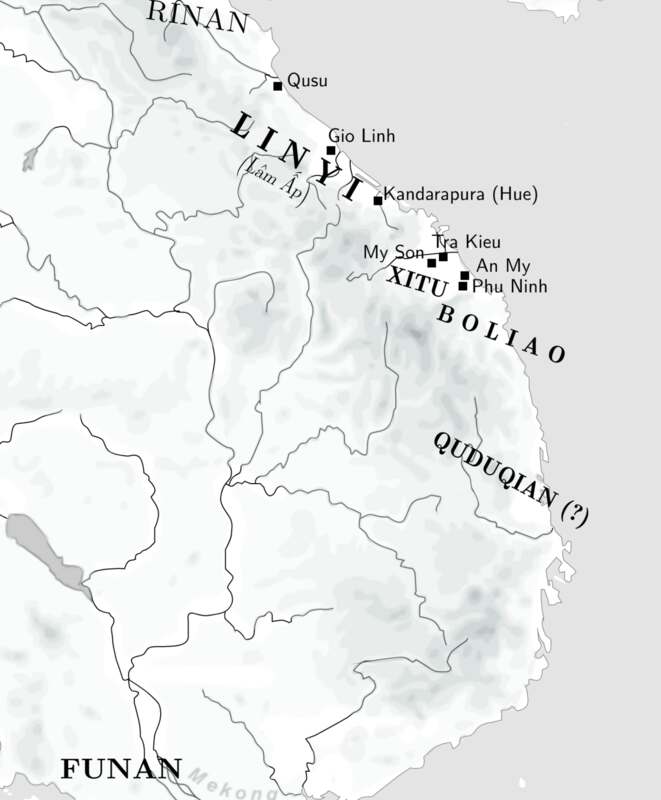
The Champa Kingdoms. Champa (192-1832) was the remarkable maritime civilization of the Vietnamese coast - a chain of Austronesian Cham kingdoms that for over sixteen centuries stood where the trade routes of China met those of India. It began in 192 CE, when a local official broke away from Chinese rule to found the kingdom known to Chinese records as Linyi. Scholars now debate how unified Champa ever was: at times a single kingdom, at times a federation of river-mouth polities, each commanding its own harbor on the long coast.
In the 4th century, wars with neighboring Funan brought Indian culture flooding into Cham society: Sanskrit became the language of inscriptions, Shaivism the religion of kings. The first king known from inscriptions, Bhadravarman (r. 380-413), founded the sanctuary of My Son, where he raised a linga joining his own name with Shiva's - and for centuries the red-brick towers of My Son and the Po Nagar temple at Nha Trang stood as the holy places of a Hindu kingdom. The Chams were the great sailors of Southeast Asia: their ports linked the spice trade from the Persian Gulf to South China, and their apogee came in the 9th and 10th centuries, when Cham merchants and sailors were known from the ports of India and Java to the Philippines.
Champa's history was written in war with its landward neighbors. With the Khmer Empire the rivalry was epic and mutual: in 1177 a Cham fleet sailed up the Mekong and sacked Angkor itself, and the Khmer king Jayavarman VII answered by conquering Champa a generation later. But the fatal pressure came from the north, from Dai Viet. Century by century the Vietnamese pushed south; in 1471 they stormed Vijaya, Champa's capital, and the old kingdom was broken, surviving only as the rump state of Panduranga until Vietnam's Nguyen dynasty annexed it in 1832.
The Cham people survived their kingdom. Cham-speaking communities still live in Vietnam and Cambodia - some Muslim, a faith that spread among the Chams from the 10th century, some keeping the old Hindu rites, one of the last living links to the Indianized age of Southeast Asia. Their language traveled too: the Acehnese of northern Sumatra speak a tongue descended from Chamic. And the towers of My Son and the old port of Hoi An, both World Heritage sites, keep the memory of the sailor-kings of Champa.
 Britannica: Champa
 Humanities LibreTexts: 7.5: Kingdom of Champa (192 CE -1832 CE)
 UNESCO World Heritage Centre: My Son Sanctuary
 National Geographic: The Cham: Descendants of Ancient Rulers of South China Sea Watch Maritime Dispute From Sidelines