 Go Back

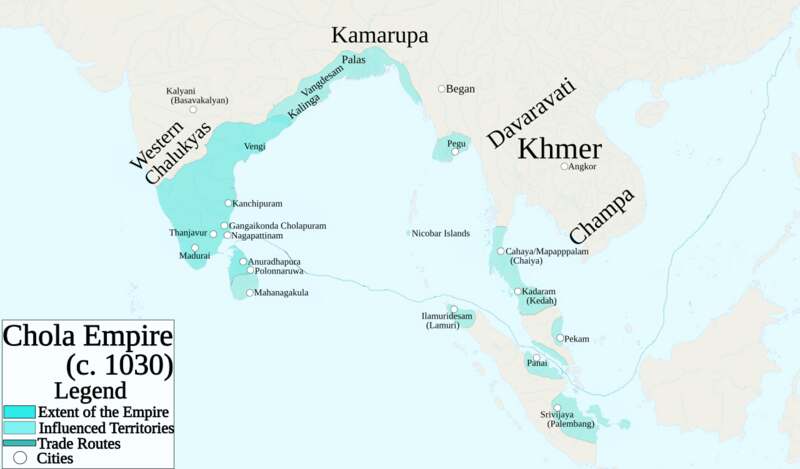
The Chola Empire. The Chola Empire (848-1279) was south India's greatest maritime power - a Tamil dynasty that held peninsular India for three centuries and ruled the waves of the Bay of Bengal. The Cholas were ancient: they appear in Ashoka's edicts of the 3rd century BCE and in the Sangam poems as one of Tamilakam's Three Crowned Kings. But the empire began in 848, when Vijayalaya, scion of an old Chola line serving the Pallavas, seized his chance and restored the dynasty from its heartland in the rich Kaveri river valley.
The imperial age opened with Rajaraja I, under whom the Cholas unified peninsular India south of the Tungabhadra as one state - a unity they held from 907 to 1215. His son Rajendra I outdid him: he marched an army north to the Ganges, completing the conquest of Rajarata in Sri Lanka on the way - styling himself Gangaikonda Chola and building a new capital, Gangaikonda Cholapuram, to prove it - and in 1025 sent the Chola fleet across the Bay of Bengal to raid the empire of Srivijaya in Sumatra, an expedition from which Srivijaya never fully recovered. Chola embassies reached China in 1016, 1033, and 1077.
The Cholas built in proportion to their ambitions. Rajaraja's Brihadisvara temple at Thanjavur - its domed sikhara resting on a single block of granite weighing some 80 tons - remains a masterpiece of Dravidian architecture, the centerpiece of a temple-building age that covered the Tamil country with stone monuments to the dynasty's power and piety.
The empire endured, through constant wars with the Chalukyas, the Pandyas, and the Sinhalese, into the 13th century; the last great king, Kulothunga III, held it together until 1215, after which the resurgent Pandyas absorbed it, and by 1279 the Chola name passed from power. Their legacy is south India's own: the Tamil country held as a single state for three centuries, the great temple cities of the Kaveri valley, and a seafaring tradition that carried Tamil commerce and culture across the Bay of Bengal to Southeast Asia.
 Britannica: Rajaraja I
 World History Encyclopedia: Chola Naval Expeditions
 Humanities LibreTexts: 7.2: Early Medieval Empires of India (550 CE – 1200 CE)
 Smithsonian Institution: Chola dynasty - National Museum of Asian Art