 Go Back

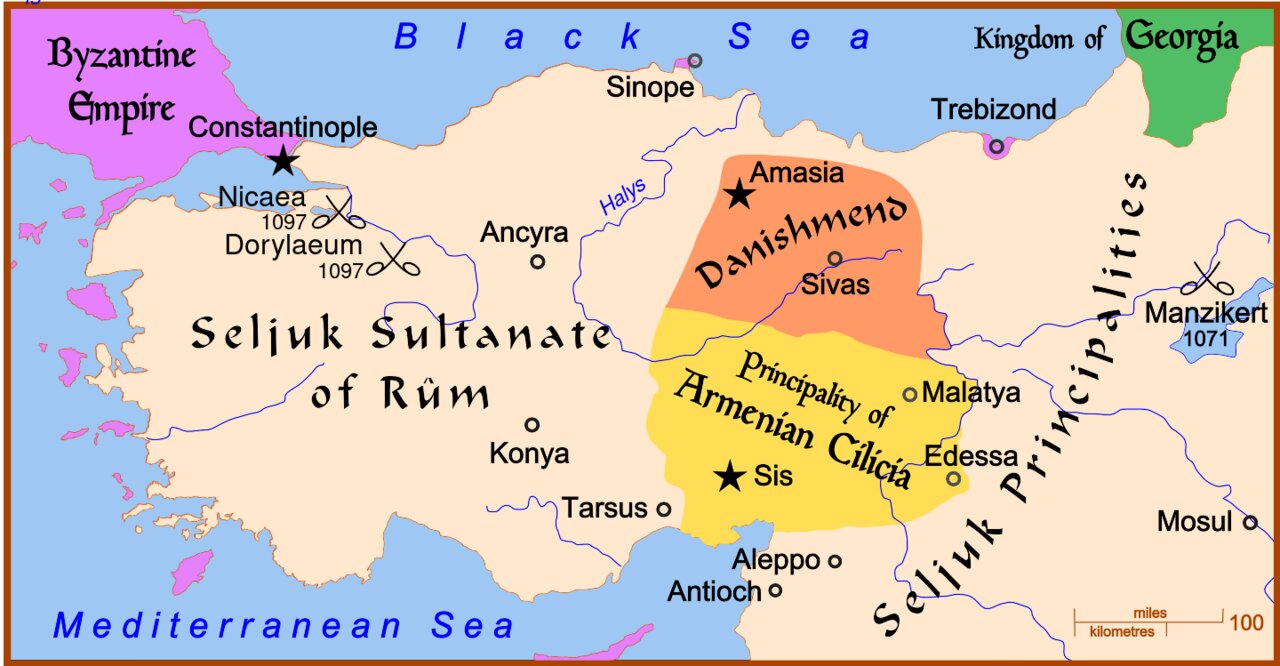
The Danishmendids. The Danishmendids (c. 1071-1178) were the first Turkish dynasty to rule central and eastern Anatolia after the Seljuk victory at Manzikert. Their founder, Danishmend Ghazi, about whom an entire Turkish epic romance (the Danishmendname) was later woven, established his power around Sivas, Niksar and Amasya in the decades when Turkish emirs, soldiers and nomads were streaming into the former Byzantine lands.
In the generation after Manzikert the Danishmendids were often the strongest Muslim power in Anatolia, stronger than their Seljuk cousins of Rum, whom they sometimes held as near-captives. Danishmend Ghazi's son Emir Gazi Gümüshtigin captured the Crusader prince Bohemond of Antioch (1100) and destroyed two whole expeditions of the Crusade of 1101 in the Anatolian highlands - victories that closed the land route across Anatolia to western armies for a generation. Under their rule cities like Kayseri (Caesarea), Sivas and Erzurum became Turkish-Islamic centers.
The dynasty's twilight came with the revival of the Seljuk Sultanate of Rum. Kilij Arslan II (r. 1156-1192) played the Danishmendid branches against each other, took Sivas in 1174, and by 1178 had extinguished the main line; cadet branches in Malatya and elsewhere lingered under Seljuk, then Mongol, overlordship into the 13th century.
Danishmendid memory survived in epic and in stone. The Danishmendname, blending history and holy-war romance, made Danishmend Ghazi a hero of Turkish popular Islam alongside his legendary companion Battal Ghazi; and the dynasty's early mosques, tombs and the great hospital (darussifa) of Divrigi - whose carved portals, built under a later Mengujekid neighbor in the same frontier world, are UNESCO-listed - mark the first flowering of Turkish architecture in Anatolia.
 Encyclopaedia Iranica: Danesmand
 The Metropolitan Museum of Art: The Art of the Seljuq Period in Anatolia (1081-1307)
 World History Encyclopedia: John II Komnenos