 Go Back

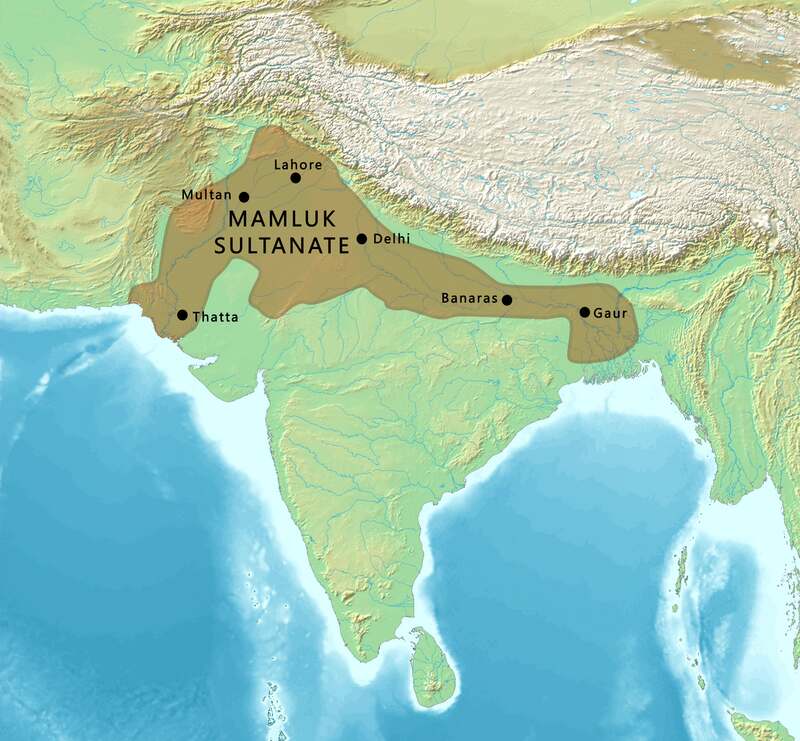
The Delhi Sultanate. The Delhi Sultanate (1206-1526) was the first great Muslim empire of India - for more than three centuries a state based in Delhi that stretched over large parts of the subcontinent. Its history falls into five dynasties: the Mamluk (1206-1290), the Khalji (1290-1320), the Tughlaq (1320-1414), the Sayyid (1414-1451), and the Lodi (1451-1526). It was founded in the ruins of the Rajput order: after Muhammad of Ghor routed Prithviraj Chauhan's confederacy near Tarain in 1192, his Turkic slave-generals divided his Indian conquests, and one of them, Qutb ud-Din Aibak, declared himself sultan at Delhi in 1206.
Aibak began the Qutb Minar and the Quwwat-ul-Islam mosque, and his son-in-law and successor Iltutmish finished the great tower while consolidating the fragile sultanate - conquering Multan and Bengal and holding the throne for a quarter-century. After his death came the age of the Corps of Forty, the kingmaker nobles, and of Razia Sultana (r. 1236-1240), one of the very few women to rule an Islamic state, until the stern Balban (1266-1287) broke the nobles and restored royal authority. In 1290 the Khaljis seized the throne in revolution.
Under Ala ud-Din Khalji, who seized the throne by murder in 1296, the sultanate became the subcontinent's terror and its shield: his armies conquered Gujarat, Malwa, and the Rajput forts, his general Malik Kafur raided deep into the south - carrying back the fabled Koh-i-Noor among the Warangal loot - and Delhi stood as one of the few powers in Asia to repel the Mongols. Ala ud-Din ruled as a tyrant, raising agricultural taxes from a fifth to half the harvest, fixing prices in state-controlled markets, and slaughtering suspected opponents with their families. Under the Tughlaqs the sultanate reached its greatest extent: Muhammad bin Tughluq briefly held most of the subcontinent and moved his capital south to Daulatabad, before overreach and revolt scattered his empire.
The blow that broke the sultanate came from outside: Timur's sack of Delhi in December 1398. Out of the wreckage rose rival powers - the Hindu Vijayanagara Empire and the Rajput kingdom of Mewar, the independent Bengal and Bahmani sultanates - while the shrunken Sayyid and Lodi dynasties held Delhi until 1526, when the Timurid prince Babur destroyed Sultan Ibrahim Lodi at Panipat and founded the Mughal Empire. Yet the sultanate's three centuries changed India permanently: it drew the subcontinent into the wider Islamic world, gave it the Hindustani language and the first masterpieces of Indo-Islamic architecture, and filled its cities with the scholars, mystics, and artisans who had fled the Mongol storm in the west.
 Britannica: Delhi sultanate
 Humanities LibreTexts: 22.4: Sultanate of Delhi
 Encyclopaedia Iranica: DELHI SULTANATE
 Smarthistory: The Qutb complex and early Sultanate architecture