 Go Back

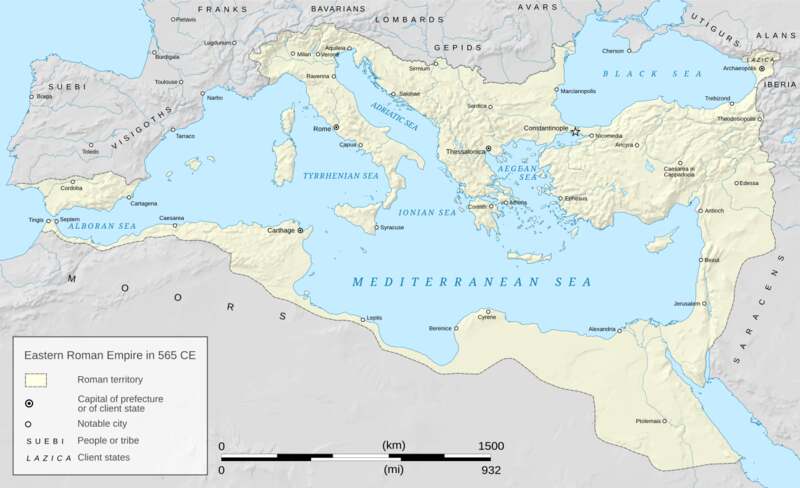
The Eastern Roman Empire (The Byzantines). The Byzantine Empire was the Roman Empire - continuing without interruption for a thousand years after Rome itself fell. Its citizens never called themselves Byzantines; they were Romans, their state Rhomania, their capital the New Rome that Constantine the Great founded on the site of Byzantium in 330. 'Byzantine Empire' is a modern label for what was, to its people and its neighbors alike, simply the Empire - Greek-speaking, Christian, and ruled from Constantinople, the greatest city of the medieval world.
Its first age of glory came under Justinian I (r. 527-565), who rewrote Roman law in the Corpus Juris Civilis - the foundation of Europe's legal tradition - rebuilt the Hagia Sophia, and sent his general Belisarius to reconquer North Africa and Italy from the Vandal and Ostrogothic kingdoms. But plague in the 540s and grinding wars with Persia followed, and in the 630s-640s the Arab conquests stripped away the Levant and Egypt, costing the empire as much as three-quarters of its revenue. The empire that survived was smaller and Greek rather than Latin, reorganized for defense through the theme system - troops assigned to defend specific provinces - behind the Theodosian Walls of Constantinople, built under Theodosius II.
The Macedonian dynasty, founded when Basil I seized the throne in 867, brought a two-century renaissance. Soldier-emperors like Nikephoros II and John Tzimiskes recovered Cilicia and Antioch, and under Basil II (r. 976-1025) - conqueror of Bulgaria after the decisive victory at Kleidion in 1014 - the empire stretched from the Danube and southern Italy to the Euphrates, its medieval peak. Then came Manzikert: in 1071 the Seljuk Turks destroyed the Byzantine field army, and Anatolia, the empire's heartland and recruiting ground, was opened to Turkish settlement. The Komnenian emperors partially restored the empire, but it was now one power among several.
The deathblow came from the West: in 1204 the knights of the Fourth Crusade sacked Constantinople and carved the empire into competing Latin realms and Greek successor states. The empire recovered its capital in 1261 under Michael VIII, but as a shadow of itself - a regional power watching the Ottoman Turks annex its remaining territories through the 14th and 15th centuries. In 1453 Constantinople finally fell to the Ottomans, and with it perished Constantine XI, the last Roman emperor. Rome's two-thousand-year story had ended.
 Britannica: How was the Byzantine Empire different from the Roman Empire?
 World History Encyclopedia: Byzantine Empire
 Humanities LibreTexts: 13: Byzantium
 The Metropolitan Museum of Art: Byzantium (ca. 330–1453)