 Go Back

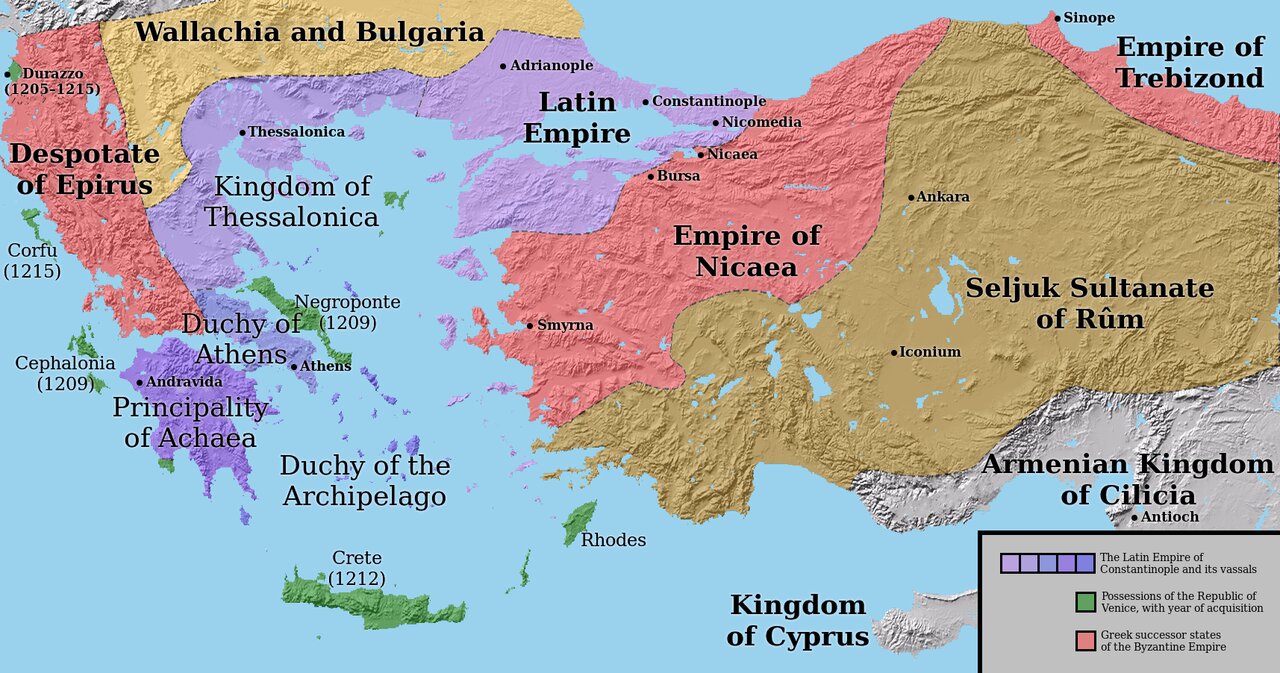
The Empire of Nicaea and the Byzantine Restoration. When the Fourth Crusade took Constantinople in 1204 and carved up the Byzantine Empire, three Greek successor states emerged - Trebizond, Epirus, and Nicaea - and it was Nicaea, across the Bosporus in northwest Asia Minor, that rebuilt Byzantium. Its founder, Theodore I Laskaris, the last emperor's son-in-law, organized the refugee government, church and army at Nicaea, was crowned emperor by a new patriarch (1208), and made his little state the magnet for Greeks who rejected the Latin Empire.
Under Theodore's son-in-law John III Vatatzes (r. 1222-1254), Nicaea became a genuine imperial power: he crushed the Latin barons of Asia Minor, won over the Balkans from his Epirote rivals, took Thessalonica (1246), and ruled a disciplined, prosperous state whose army, treasury and learned court - he stocked libraries and schools - were the envy of the Greek world, remembered with affection as 'the Father of the Greeks'. His brief successor Theodore II, a scholar-emperor, prepared the restoration.
The final act belonged to Michael VIII Palaiologos, an ambitious aristocrat who made himself regent and then co-emperor for the child John IV (whom he later blinded - a crime that shadowed his dynasty). In 1261 his general Alexios Strategopoulos retook Constantinople almost by accident with a handful of men, finding the Latin garrison away on a raid; on 15 August 1261 Michael entered the city in triumph and was crowned, restoring the Byzantine Empire after 57 years of Latin rule.
Nicaea's legacy was double-edged: it preserved and restored Byzantium, its scholars (Blemmydes, Akropolites) led a Greek intellectual revival, and its diplomacy with Genoa (Treaty of Nymphaeum, 1261) outmaneuvered Venice - but Michael VIII's obsession with the west and the crusading threat left Asia Minor, the empire's old heartland, open to the Turks, who took it within a generation. The restored Palaiologan empire would linger, shrinking, until 1453.
 World History Encyclopedia: Empire of Nicaea
 Britannica: Michael VIII Palaeologus
 The Metropolitan Museum of Art: Constantinople after 1261