 Go Back

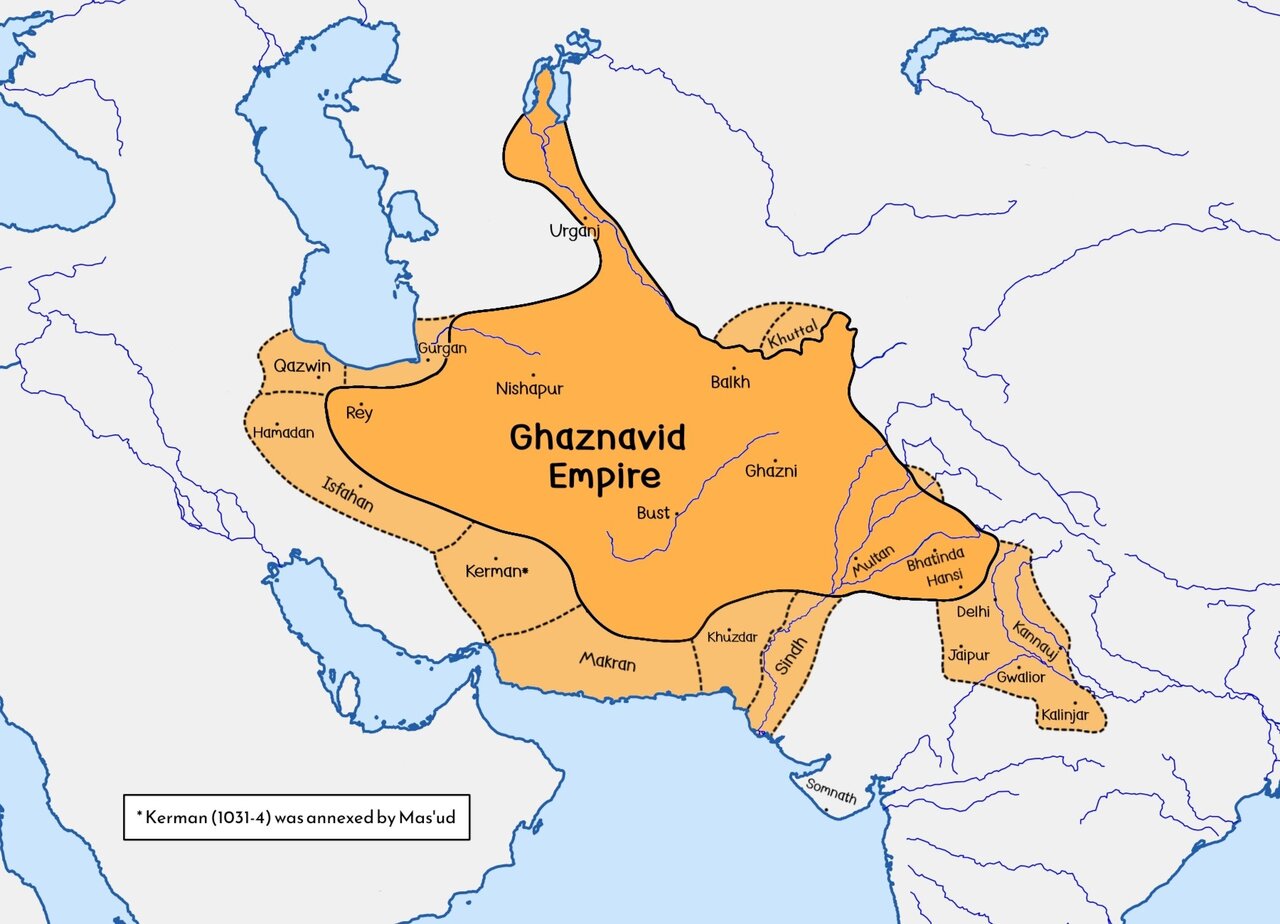
The Ghaznavid Empire. The Ghaznavid Empire (977-1186) was the first great Turko-Persian sultanate, founded by Sabuktigin, a Turkic slave-soldier (mamluk) who seized the governorship of Ghazna (in modern Afghanistan) from his Samanid masters. His son Mahmud of Ghazna (r. 998-1030) made it an empire: from his Afghan capital he ruled Khorasan, Afghanistan, and at his peak much of Iran, and he became the most feared conqueror of his age for his seventeen expeditions into India.
Mahmud's Indian campaigns - against the Hindu Shahis, the cities of the Punjab, and deep raids as far as Kannauj, Mathura and the fabulously rich temple of Somnath (1025-26) - carried off immense plunder and annexed the Punjab permanently to an Islamic state, the opening wedge of Muslim rule in northern India. His enemies remembered him as an idol-smasher; his own court remembered him as a ghazi champion of Sunni Islam, recognized by the Abbasid caliph and hostile to the Shi'a Buyids and Ismailis alike.
Mahmud spent his plunder on culture. Ghazna was briefly one of the intellectual capitals of the Islamic world: the poet Firdawsi dedicated the Shahnameh, the Persian national epic, to him (and was famously disappointed by his reward); the great polymath al-Biruni, taken from Khwarazm, wrote his celebrated study of India at the Ghaznavid court; and historians like al-Utbi and Bayhaqi chronicled the empire in Persian and Arabic. The dynasty's patronage decisively established New Persian as the literary language of the eastern Islamic world.
Mahmud's son Mas'ud lost the western half of the empire to the Seljuk Turks at Dandanqan (1040), and the later Ghaznavids ruled on in Afghanistan and the Punjab, moving their capital to Lahore, until the Ghurids took Ghazna (1150) and finally Lahore (1186). Their legacy: Persianate Islamic civilization planted permanently in India, where Lahore and Delhi would inherit it.
 Britannica: Ghaznavid dynasty
 Encyclopaedia Iranica: Ghaznavids
Encyclopaedia Iranica: Mahmud b. Sebuktegin