 Go Back

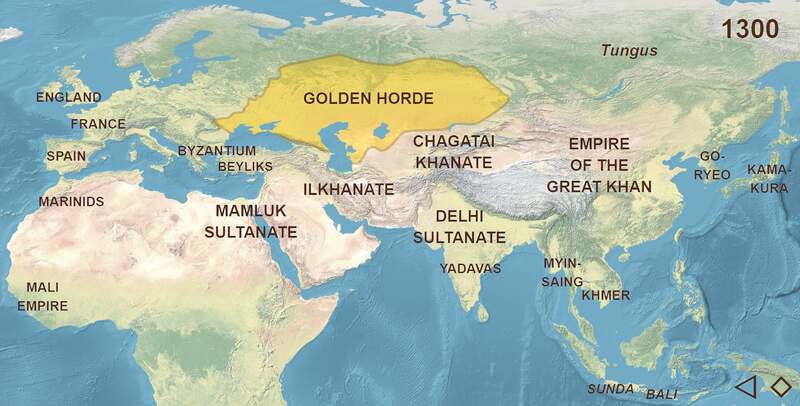
The Golden Horde. The Golden Horde - the Ulus of Jochi, its rulers called it - was the northwestern quarter of the Mongol Empire, and for two centuries the master of Russia. It grew from the lands assigned to Jochi, Genghis Khan's eldest son, but its real founder was Jochi's son Batu, whose great western campaign with the general Subutai conquered Volga Bulgaria and then the Russian principalities - Ryazan fell in December 1237, Kiev was sacked in the winter of 1240-41 - before his armies smashed the Poles and Hungarians at Legnica and Mohi in 1241. From his new capital at Sarai on the lower Volga, Batu and his heirs ruled from Siberia to the Danube - and collected tribute from every Russian prince.
The Russian principalities kept their own rulers and their Orthodox faith; the Horde demanded submission and tribute, and its word was law: the princes of Rus' traveled to Sarai to acknowledge the khan's supremacy and renew their patents of rule. The khans themselves changed faith and language: Batu's brother Berke, enthroned in 1257, was a convert to Islam, and under Özbeg Khan (1312-1341) - who made Islam the state religion - the Horde reached its peak, its Mongol ruling class by then thoroughly Turkicized, speaking the Kipchak tongue of their steppe subjects.
Sarai itself was a cosmopolitan capital where the khans licensed churches as well as mosques. But the mid-14th century brought the 'Great Troubles' (1359-1381), a generation of civil war between rival khans. Tokhtamysh briefly reunited the Horde (1381-1395), only for Timur's invasion of 1396 to shatter it for good: the khanate broke into smaller khanates that declined steadily in power.
The wreck broke into successor khanates - Kazan, Astrakhan, Crimea, the Nogai and Uzbek hordes - while the shrunken 'Great Horde' on the Volga clung to its claims until 1480, when the famous 'stand on the Ugra River' ended with the khan's army simply turning away: the traditional end of the 'Tatar yoke' over Russia. In 1502 the Crimean khan sacked Sarai itself. Yet the Horde's shadow was long: the Crimean Khanate, its last heir, survived until 1783 - five and a half centuries after Batu rode west.
 Britannica: Golden Horde
 World History Encyclopedia: Golden Horde
 Encyclopaedia Iranica: GOLDEN HORDE
 National Geographic: Why the unstoppable Mongol Empire halted their European conquest