 Go Back

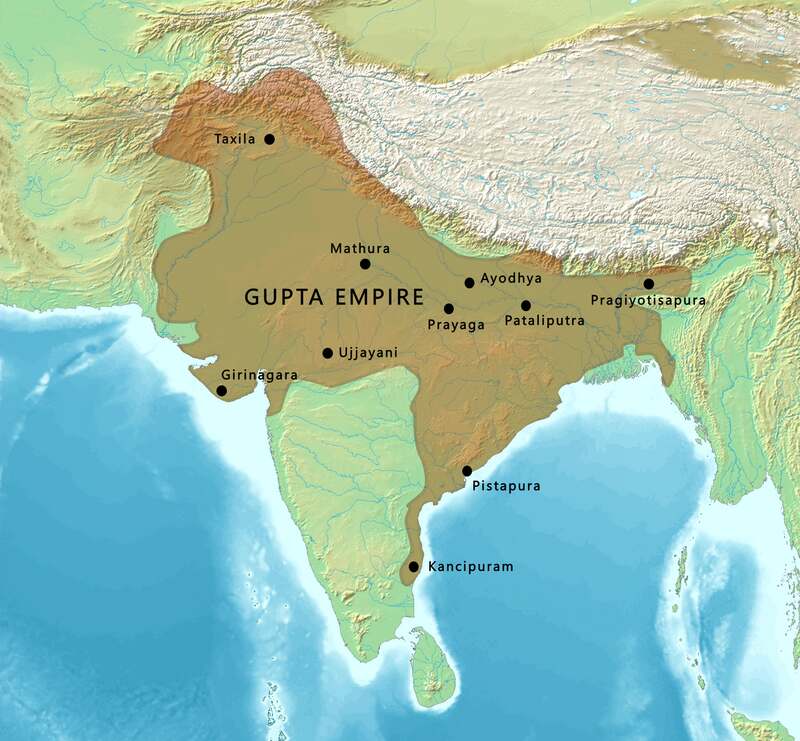
The Gupta Empire. The Gupta Empire (c. 320-550) ruled northern India during what many historians call India's Golden Age - a label some modern scholars dispute, but one the age's achievements make hard to resist. Founded by Chandragupta I, crowned in 320 at Pataliputra, the dynasty rose from a local Magadha kingdom - its position strengthened by his marriage to the Licchavi princess Kumaradevi - to an empire spanning most of the northern subcontinent.
Its greatest conqueror, Samudragupta (c. 335-375), is known to us largely through his own court poet's panegyric, the Allahabad Pillar inscription, which claims he uprooted eight kings of the north, defeated twelve rulers of the south, and received tribute from the forest tribes and the frontier kingdoms from Nepal to Assam - claims modern historians read with care, since the inscription dressed diplomacy as submission. He performed the ancient horse sacrifice of imperial sovereignty and minted gold coins showing him playing the veena: a 'king of poets' as well as a conqueror.
Under Samudragupta's son Chandragupta II and grandson Kumaragupta I, the empire enjoyed its Pax Gupta. The age's culture set the standards of Indian art and thought for a thousand years: the Mahabharata and Ramayana took their classical written form, the Puranas were compiled, Kalidasa wrote the works that remain Sanskrit literature's summit, while Aryabhata, Varahamihira, and Vatsyayana made their lasting advancements in scholarship. Hindu in allegiance - the Guptas patronized Brahmanical ritual - the empire was tolerant of other faiths, and its art 'set standards of form and taste that determined the whole subsequent course of art, not only in India but far beyond her borders'.
The end came from the steppe. From the late 5th century the Huna peoples - the Kidarite and Alchon Huns of Central Asia - broke through the northwest frontier, and the empire's own feudatories carved away its territory; by around 550 the Guptas were gone and India fragmented again into regional kingdoms. But the template endured: for later Indians, the Gupta age remained the classical standard of kingship, art, and learning - the age against which all later Indian civilization measured itself.
 Britannica: Gupta dynasty ❘ Chandragupta I, Samudragupta, Chandragupta II, Kumaragupta, Skandagupta, Founder, Rulers, History, Culture, Architecture, & Classical Age
 World History Encyclopedia: Gupta Empire
 Humanities LibreTexts: 3.11: The Gupta Empire and India's Classical Age (300-600CE)
 Smarthistory: The Gupta Period