 Go Back

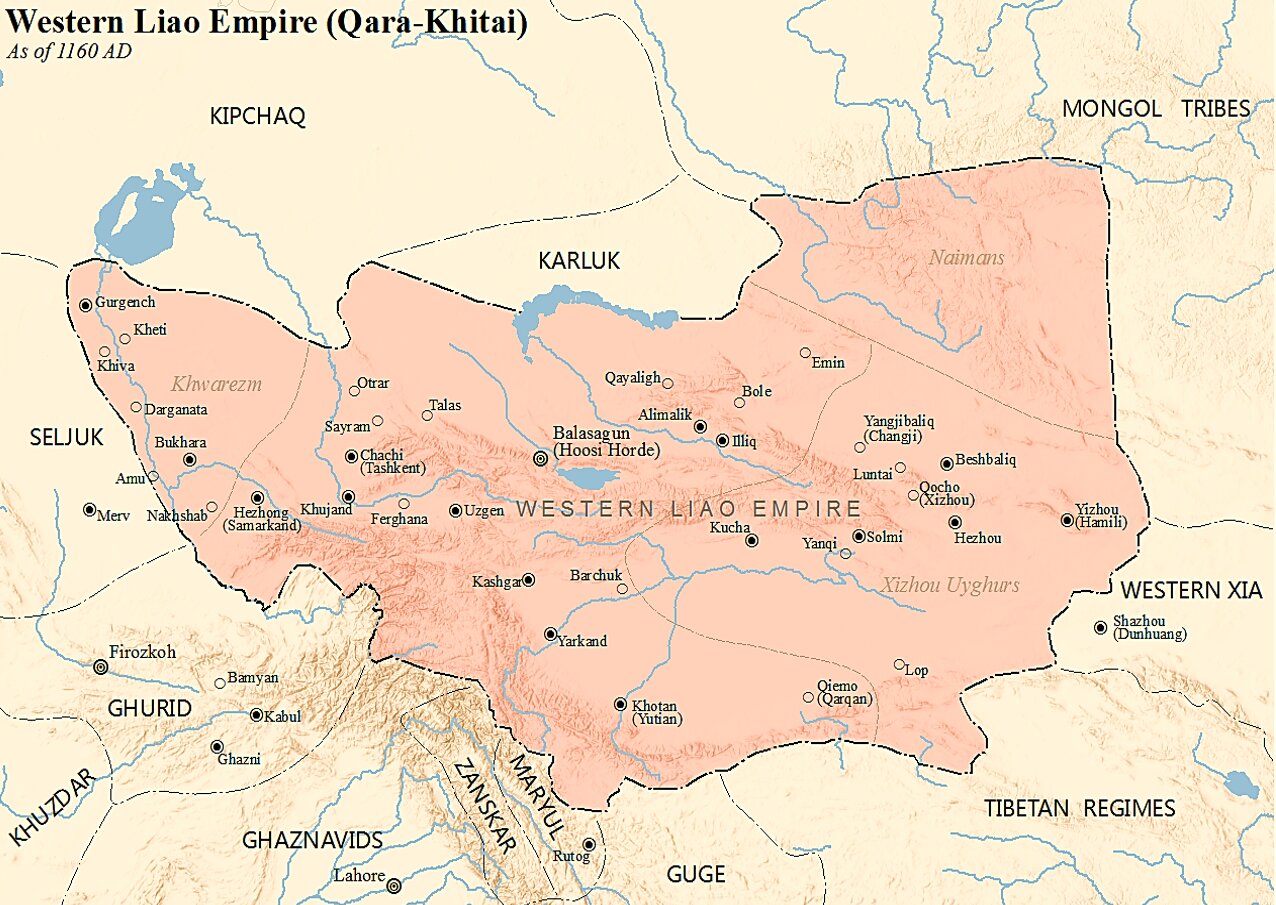
The Kara Khitai. The Kara Khitai (1124-1218), the 'Black Khitan' or Western Liao, were one of history's great imperial re-foundations. When the Jurchens destroyed the Liao dynasty in North China, the Khitan prince Yelü Dashi refused surrender: with a few hundred followers he rode west across the steppe in 1124, rallied the tribes of Mongolia, and rebuilt an empire in Central Asia with its capital at Balasagun (in modern Kyrgyzstan), taking the title gurkhan, 'universal khan'.
At their height the Kara Khitai ruled from the Oxus to the Altai: the Qarakhanid khanates of Kashgar and Samarkand, the Uyghurs, the Qarluks, and for a time the rising Khwarazmians all paid them tribute. Their decisive victory came at Qatwan, north of Samarkand (1141), where Yelü Dashi destroyed the army of the Seljuk sultan Sanjar - a battle that ended Seljuk power east of the Oxus and, in European retelling, grew into the legend of the Christian priest-king Prester John.
The Kara Khitai kept the Liao dual system: Chinese-style administration and titles for the settled lands, steppe custom for the tribes. They were religiously plural - Buddhist Khitan rulers over mostly Muslim subjects, with Nestorian Christian, Jewish and shamanist communities - and Muslim writers praised their justice and the security of the trade routes under the gurkhans. Their rule preserved Central Asia's prosperity through the 12th century.
The end came from within and without: the last gurkhans weakened the empire with wars against the rising Khwarazmshah, and in 1211 Kuchlug, a fugitive Naiman prince, usurped the throne and alienated the Muslim population with forced conversions. When Genghis Khan's general Jebe arrived in 1218, the cities surrendered without a fight. The Kara Khitai were forgotten in the West - except in the echo of their name: 'Cathay'.
 Encyclopaedia Iranica: Qara Ketay (Qara Khitai)
 Humanities LibreTexts: Mongol Expansion Throughout Central and Western Asia
Encyclopaedia Iranica: Central Asia in the Islamic Period up to the Mongols