 Go Back

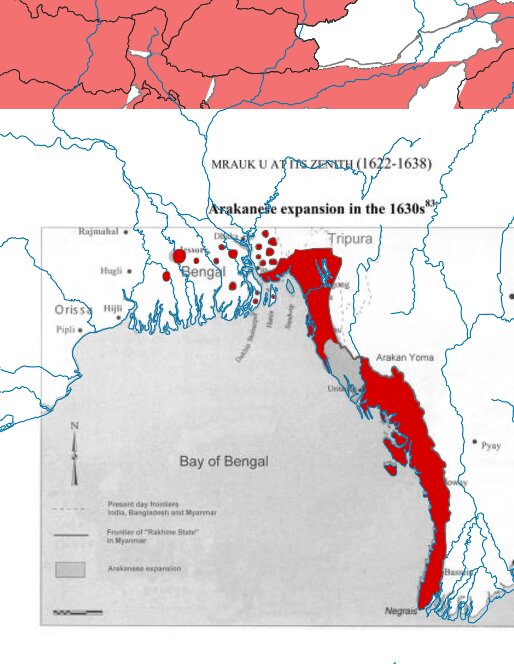
The Kingdom of Arakan. The Kingdom of Arakan (1429/1430-1785), with its capital at Mrauk U, ruled the narrow coastal strip of western Burma between the Arakan mountains and the Bay of Bengal - a frontier kingdom where Burmese, Bengali and maritime worlds met. Its golden age began when King Narameikhla (Min Saw Mon), restored from exile in Bengal with the help of the Bengal Sultanate, founded Mrauk U in 1430, acknowledging nominal Bengali suzerainty - a link that left Arakan's kings with Muslim-style titles and coins alongside their Buddhist ones.
In the 16th-17th centuries Mrauk U was a power in the Bay of Bengal. Arakanese kings like Min Bin (r. 1531-1553) - who defended his kingdom against the Burmese conqueror Tabinshwehti and briefly occupied Chittagong - and their successors commanded fleets of fast galleys manned by Arakanese and Portuguese mercenaries, raiding deep into Bengal. The slave-trading port of Dianga and the Portuguese-tinged court of Mrauk U grew rich on rice, slaves, and the Bengal trade; the Flemish merchant Wouter Schouten and friar Sebastien Manrique left vivid accounts of the court.
Mrauk U's cityscape still proclaims its power: tens of thousands of pagodas and massive fortress-like stone temples - the Shitthaung ('temple of 80,000 images') and Htukkanthein - built of dressed stone against the monsoon, unique in Burmese architecture. The court sponsored Pali scholarship and a distinctive Arakanese literature.
Weakened by succession murders, Portuguese freebooting, and Mughal pressure from Bengal (which took Chittagong in 1666), the kingdom slid into a century of palace coups, and in 1785 the Burmese king Bodawpaya conquered it, carrying off its sacred Mahamuni Buddha image to Mandalay - a wound at the heart of Arakanese (Rakhine) identity to this day.
 Britannica: Arakanese Kingdom of Mrohaung
Britannica: Arakan
Britannica: Toungoo Dynasty