 Go Back

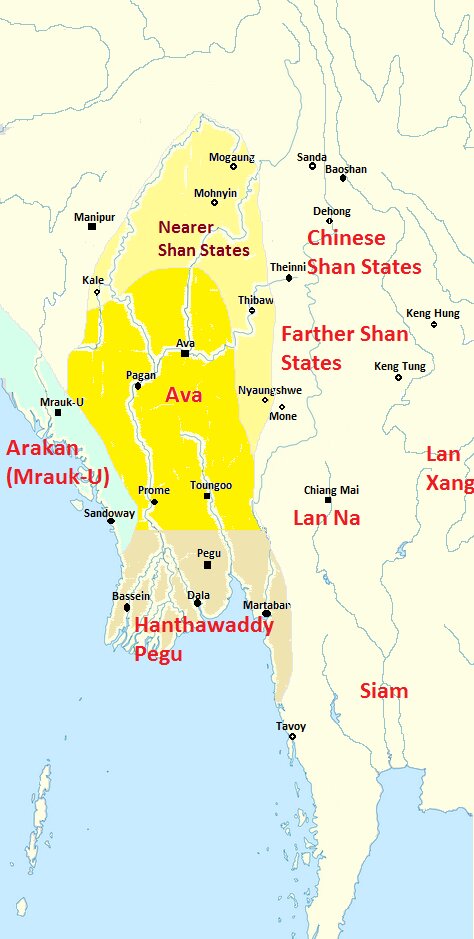
The Kingdom of Ava. The Kingdom of Ava (1364-1555) ruled the Irrawaddy heartland of Upper Burma from its capital at Ava (Inwa), on the river below Mandalay. Founded by Thado Minbya after the Mongol invasions had shattered the Pagan Empire, Ava fought a long 'Forty Years' War' (1385-1424) against the Mon kingdom of Hanthawaddy (Pegu) in the south for the mastery of Burma - an exhausting stalemate that defined two generations of Burmese and Mon history.
Ava's kings presided over a flowering of Burmese culture even in wartime: the court made Burmese the language of high literature, produced great court poets and Buddhist scholarship, and maintained the intricate irrigation systems of the Kyaukse rice plain on which its power rested. But the kingdom was chronically weak at the center: its Shan vassal chiefs (sawbwas) of the northern hills grew ever more independent, and Ava survived by balancing them against each other and against the rising Shan state of Mogaung.
In 1527 the Shan confederation under Sawlon of Mohnyin sacked Ava itself, and for three decades Upper Burma was ruled by Shan chiefs while the Burmese looked south to the rising power of Toungoo. In 1555 the Toungoo king Bayinnaung - the greatest conqueror in Burmese history - took Ava and reunified the country, and Ava became a provincial (though twice again royal) capital.
Ava's four centuries made it the classical heartland of Burmese identity: the Burmese language, orthography, Theravada orthodoxy and court culture of later Burma were formed there, and its ruins at Inwa - walls, watchtower, monasteries - stand amid the rice fields south of Mandalay.
 Britannica: Ava
Britannica: Bayinnaung
 Humanities LibreTexts: Burmese Art