 Go Back

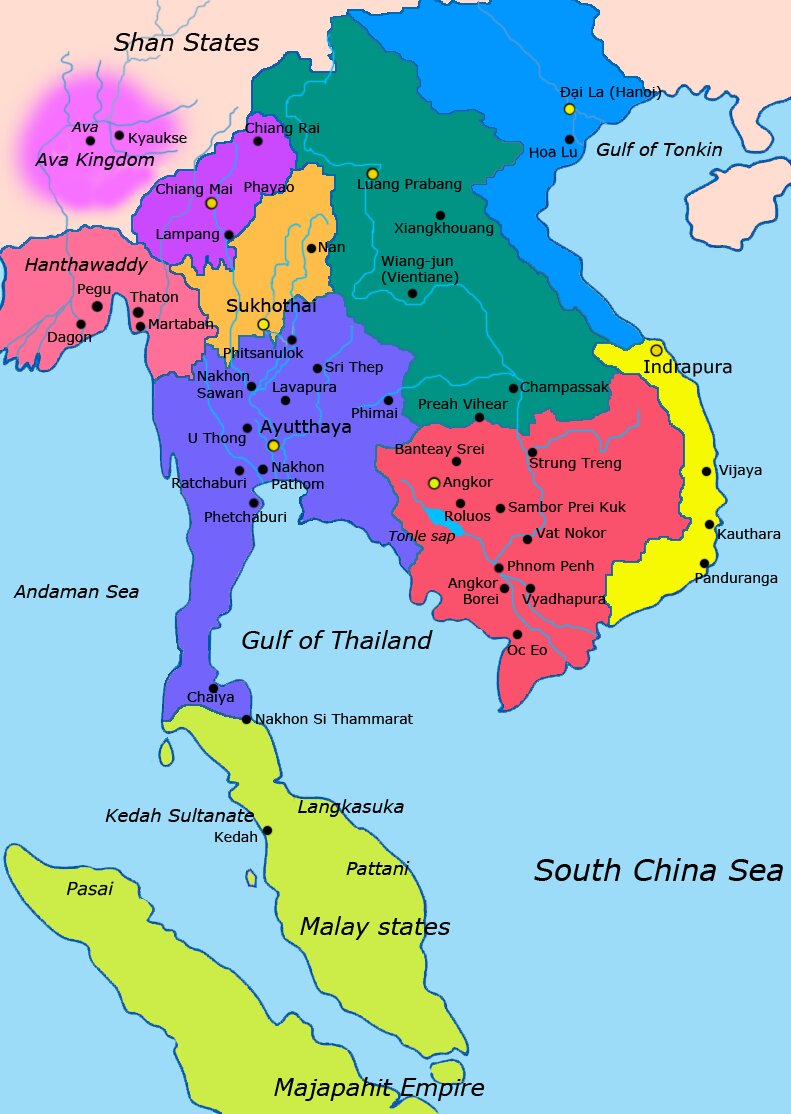
The Kingdom of Lan Xang. Lan Xang ('Land of a Million Elephants', 1353-1707) was the first kingdom of the Lao people and the ancestor of modern Laos. It was founded by Fa Ngum, a Lao prince raised at the Khmer court of Angkor, who returned with a Khmer army, conquered the Lao principalities of the Mekong valley, and was crowned at Luang Prabang in 1353, bringing with him Theravada Buddhism and the palladium of the kingdom - the Phra Bang, the gold Buddha image from which Luang Prabang takes its name.
Under kings like Sam Sen Thai and Visoun in the 15th-16th centuries, Lan Xang held the middle Mekong against Vietnam, Ayutthaya and Burma, prospering on the river trade and forest products. The Burmese wars of the 1560s forced King Setthathirath to move his capital south to Vientiane (1560) - and to carry there the Phra Bang and the Emerald Buddha, the two great palladia of the Lao (the latter later seized by Siam and now in Bangkok). Setthathirath, builder of Vientiane's That Luang stupa, Laos' national monument, disappeared on campaign in 1571, and the kingdom fell into a half-century of succession struggles and Burmese interventions.
Lan Xang's golden age came late, under Sourigna Vongsa (r. 1637-1694), whose long, stern and prosperous reign from Vientiane impressed the first European visitors - the Jesuit Leria and the Dutch merchant Van Wuysthoff - with the kingdom's wealth and discipline. But he died without naming an heir, and in 1707 Lan Xang split into three rival kingdoms - Luang Prabang, Vientiane and Champasak - easy prey for Siam and Vietnam in the century that followed.
Lan Xang remains the Lao nation's founding charter: the Phra Bang, the That Luang, and the memory of the million-elephant kingdom anchor Lao identity, and its 18th-century breakup explains both modern Laos' borders and its long subordination to Siam.
 Britannica: Lan Xang
Britannica: Louangphrabang
Britannica: Lan Xang