 Go Back

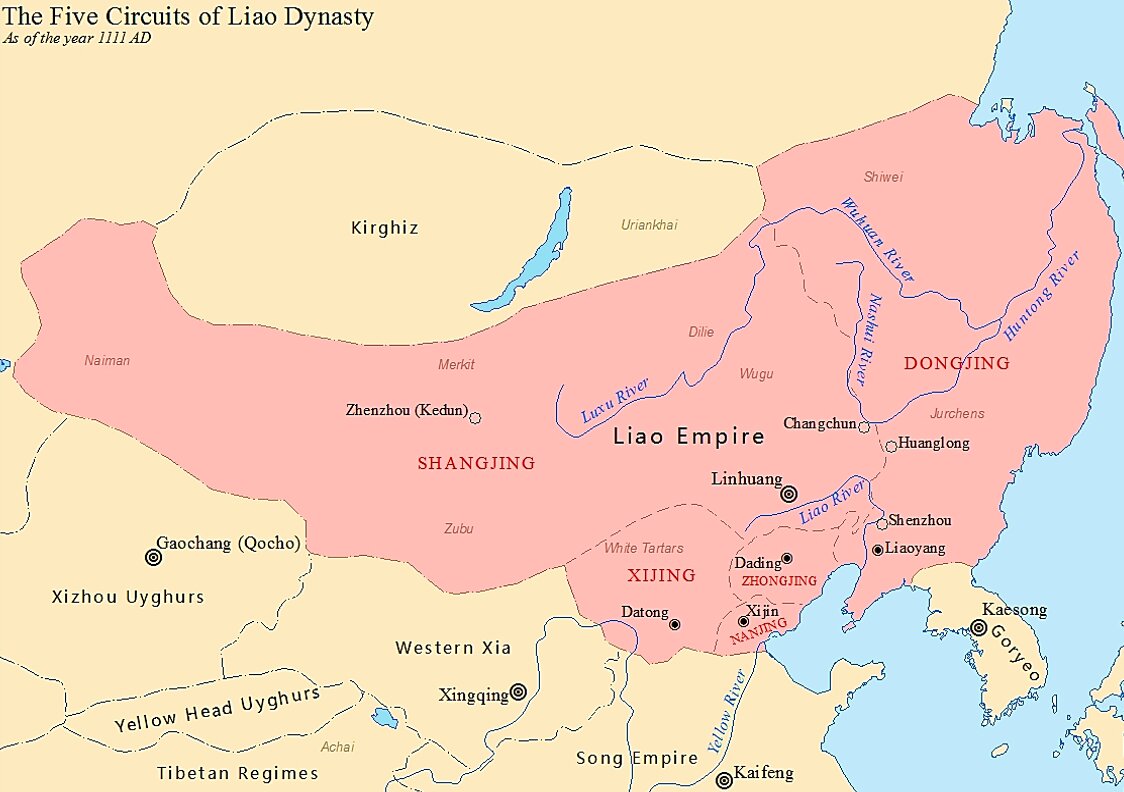
The Liao Dynasty. The Liao dynasty (907-1125) was founded by the Khitans, a nomadic people of the Manchurian steppe, under Abaoji (Emperor Taizu), who proclaimed himself khan and then Chinese-style emperor - the first of the great 'conquest dynasties' that would rule North China for the following four centuries. His successors took the Sixteen Prefectures of North China (938), including modern Beijing, which became their southern capital and a Chinese metropolis for the first time under non-Chinese rule.
The Liao invented a new kind of empire: dual administration. A 'northern administration' governed the Khitan and other steppe peoples by their own tribal law and customs; a 'southern administration' governed the millions of Chinese farmers by Chinese bureaucratic practice. The dynasty maintained five capitals, created Khitan large and small scripts for its language, and its emperors performed both the Chinese imperial rites and the rituals of steppe kingship - a template the Jin, Yuan and Qing would all follow.
Liao China prospered: its artisans produced fine three-color (sancai) ceramics, its wooden pagodas - like the towering Sakyamuni Pagoda of Ying County (1056), the oldest and tallest wooden pagoda in the world - and its monasteries show a vigorous, conservative Buddhist culture. After a long war, the Liao and the Chinese Song dynasty made the Treaty of Chanyuan (1005): a century of peace in which Song paid annual subsidies and the two courts addressed each other as equals - a landmark in East Asian diplomacy.
The dynasty was destroyed by its own vassals: the Jurchens under Aguda rebelled in 1114 and, allied with the Song, crushed the Liao by 1125. One branch fled west under Yelü Dashi and founded the Qara Khitai empire in Central Asia. The Khitan name lived on as 'Cathay' - for centuries the word for China itself in Persian, Russian and medieval Europe.
 Britannica: Liao dynasty
 World History Encyclopedia: Khitan
 Humanities LibreTexts: Hybrid States in Northern China and the Steppe