 Go Back

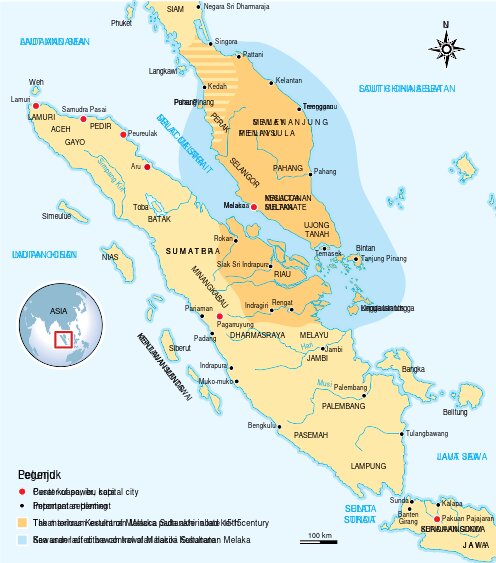
The Malacca Sultanate. The Malacca Sultanate (c. 1400-1511) was the greatest Malay commercial empire and the pivot of Asian trade in the 15th century. Its founder, Parameswara - a fugitive prince of Srivijaya from Palembang via Temasek (Singapore) - settled at the fishing village of Malacca around 1400, on the narrowest point of the strait that bears its name, the choke point of all shipping between the Indian Ocean and the South China Sea.
Malacca's rise was deliberate and diplomatic: it protected traders, kept the strait free of pirates, standardized tolls and weights, and won the patronage of Ming China - Parameswara himself sailed to the Ming court, and Zheng He's treasure fleet used Malacca as a fortified depot. Merchants from Gujarat, Bengal, Arabia, Persia, Java, the Ryukyus and China crowded its port; one observer counted eighty-four languages spoken there, and the Venetian Suma Oriental called it the best market in the world.
From mid-century Malacca became an empire and the engine of Islamization: its sultans - above all Mansur Shah (r. 1459-1477) - extended control over both shores of the strait and the tin-rich Malay interior; its royal chronicles, the Sejarah Melayu (Malay Annals), were composed at its court; and Islam, adopted by its rulers, spread with Malaccan trade and prestige to Java, Sumatra, Borneo, the Moluccas and the southern Philippines. Malay became the region's lingua franca.
In 1511 the Portuguese under Afonso de Albuquerque stormed the city - the first European conquest in Southeast Asia - seeking to seize the spice trade at its source. The sultan fled to found the Johor dynasty, and Muslim trade partly shifted to Aceh and Johor, but Malacca's century had fixed the Malay world's religion, language, and royal ideal; its chronicles remain the charter myth of Malaysia.
 Britannica: Sultanate of Malacca
 Humanities LibreTexts: The Malacca Sultanate
 World History Encyclopedia: Portuguese Malacca