 Go Back

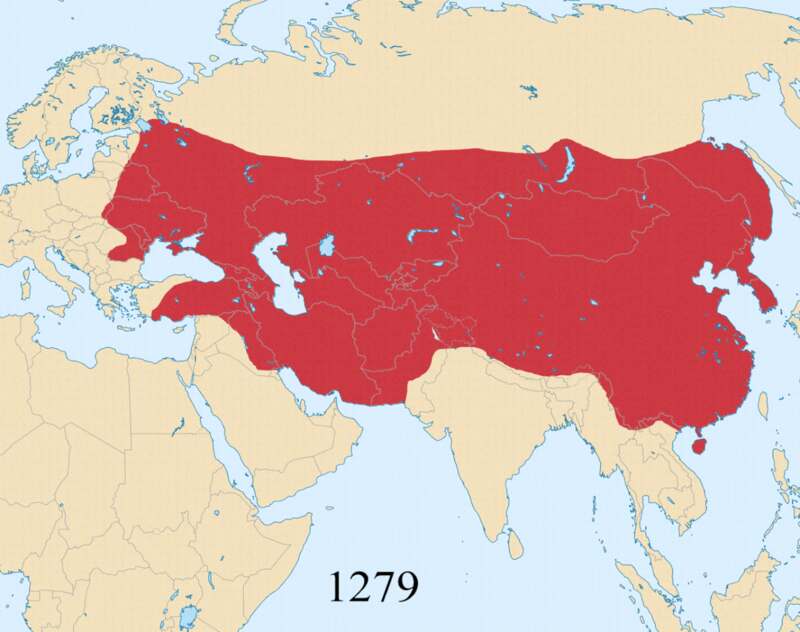
The Mongol Empire. The Mongol Empire was the largest contiguous land empire in all of history - at its height stretching from the Sea of Japan to Eastern Europe, from Siberia to the borders of India. It was the creation of one man: Temüjin, born around 1162, abandoned by his tribe on the steppe after his father was poisoned, who fought his way from fugitive to master of Mongolia. In 1206 a great assembly, the kurultai, proclaimed him Genghis Khan, ruler of the 'Great Mongol Nation'.
Genghis did not just unite the tribes; he abolished them. In what the historian Timothy May calls a 'social revolution', he broke up the old tribal loyalties and reforged the steppe into a decimal army - units of ten, a hundred, a thousand - commanded by ninety-five chosen officers, some of humble birth, loyal to him alone. This machine, disciplined and mobile, campaigned against the Jin dynasty and the Western Xia in northern China and destroyed the Khwarazmian Empire; when Genghis died in 1227 his empire already stretched from the Pacific to the Caspian, twice the size of Rome's at its height. Under his son Ögedei the conquests rolled on: the Jin dynasty finished by 1234, Goryeo Korea reduced to a client state, Kievan Rus' overrun, and in 1241 victories at Legnica and on the Sajo River carried Mongol armies into Poland and Hungary.
The empire Genghis founded was more than a war machine. Under the Pax Mongolica, the 'Mongol Peace', the routes from the Pacific to the Mediterranean lay under one power's protection for the first time: merchants, missionaries, technologies, commodities, and ideologies crossed Eurasia as never before. But the succession law never matched the conquests. Genghis's grandsons fought over the inheritance, and after Möngke Khan died in 1259, the Toluid Civil War (1260-1264) between his brothers Kublai and Ariq Böke broke the empire's unity for good.
By Kublai Khan's death in 1294 the empire had become four sovereign khanates: the Golden Horde in Russia, the Chagatai Khanate in Central Asia, the Ilkhanate in Iran, and Kublai's own Yuan dynasty in China. They fell in turn - the Ilkhanate by 1353, the Yuan to the Ming in 1368, the Golden Horde by the end of the 15th century - while Chagatai's heirs lasted, in one corner or another, into the 1700s. In barely a century and a half the Mongols had conquered half the known world and lost it, and in the process rewired it: the Silk Road age they opened, and the devastation they left, shaped everything that came after.
 Britannica: Mongol empire
 World History Encyclopedia: Mongol Empire
 Humanities LibreTexts: 9.1: Overview of the Mongol Empire
 National Geographic: Mongols—facts and information