 Go Back

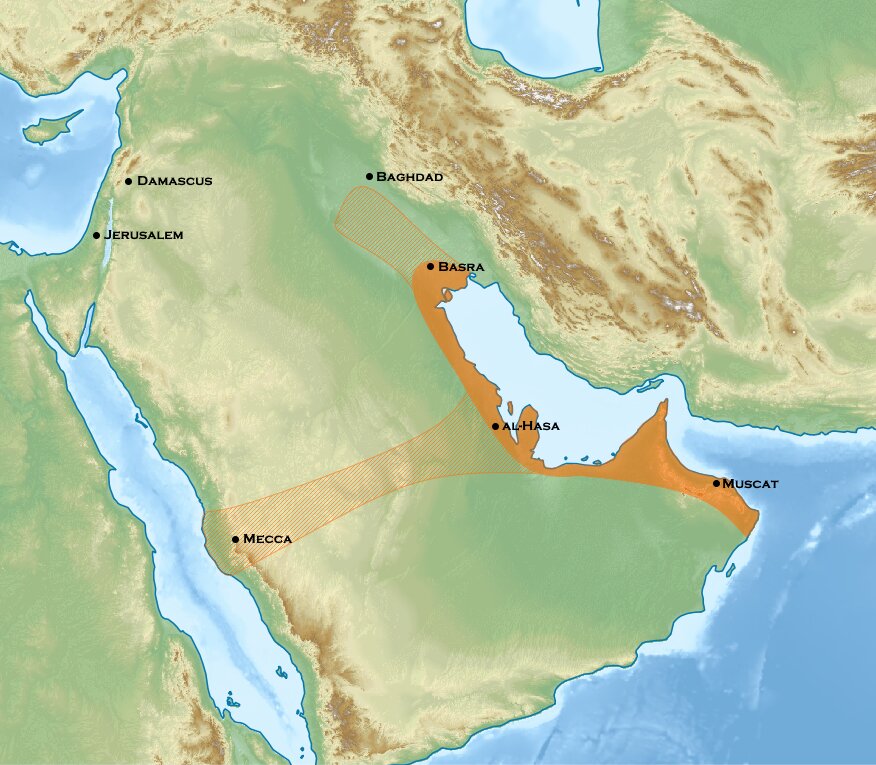
The Qarmatians. The Qarmatians (899-1077) were a radical Ismaili Shi'a movement that built a breakaway state in Bahrayn (eastern Arabia) and terrorized the Abbasid world for two centuries. Founded on Ismaili missionary work among the tribes and peasants of the Gulf by missionaries of the hidden Ismaili imam, the movement in Bahrayn rejected the claims of the Fatimids when they declared themselves in 909, and under Abu Tahir al-Jannabi became the scourge of Iraq and Syria.
The Qarmatian state at al-Ahsa (al-Hasa), with its capital al-Mu'miniyya, was an anomaly: a communal, reportedly egalitarian society of shared property and conscript labor, run by a council of the ruling family and notables, without the usual apparatus of mosques and orthodoxy. Their power rested on Bedouin cavalry, on taxing the Gulf trade and the pilgrim routes, and on sheer terror: in 906 and again in the 920s they cut the pilgrimage caravans, and in 924-925 they reached the gates of Kufa and Basra.
Their most infamous act came in 930: the Qarmatians stormed Mecca itself during the pilgrimage season, massacred pilgrims, and carried off the Black Stone of the Kaaba to al-Ahsa - an act of sacrilege that scandalized the entire Muslim world. They held it for over twenty years, returning it in 951 only after negotiations and payment, reportedly to test the Fatimid claim to be the true imams.
From the later 10th century the movement faded into a local Gulf principality, fighting losing wars against the Uyunids and local tribes, and its distinct doctrine dissolved by the 11th-12th centuries. The Qarmatians remain the great heresiarch bogey of medieval Sunni and Fatimid literature alike - remembered above all for the stolen Black Stone, the darkest possible symbol of the 10th century's collapse of caliphal authority.
 Britannica: Qarmatian
 Encyclopaedia Iranica: Carmatians
Encyclopaedia Iranica: Hamdan Qarmat