 Go Back

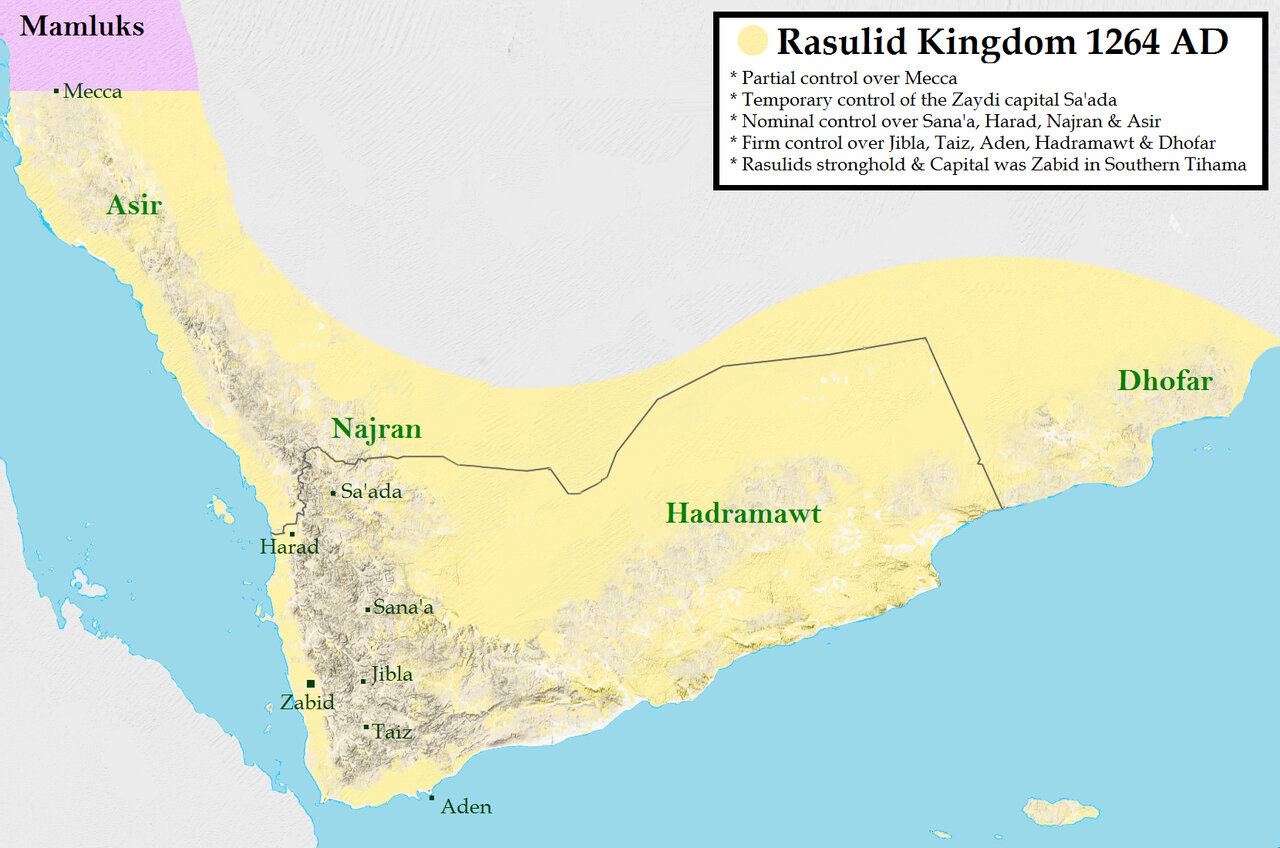
The Rasulid Dynasty of Yemen. The Rasulids (1229-1454) ruled Yemen for two centuries as heirs of the Ayyubids, whose governor Nur al-Din Umar - a Turkic mamluk commander - stayed on as an independent sultan when the Egyptian overlords withdrew. From capitals at Zabid and Ta'izz, the Rasulids built what historians often call medieval Yemen's golden age: a stable, wealthy kingdom controlling both the highlands and the coasts of Arabia's southwest corner.
Rasulid prosperity rested on Aden. The port sat where the Indian Ocean trade met the Red Sea route to Egypt, and the sultans taxed the flow of spices, textiles and horses between India, East Africa, and the Mediterranean, maintaining a fleet, ambitious diplomatic relations with the Mamluks, and a customs system that made Aden one of the busiest harbors of the 13th-15th century world - visited by the merchants whose records fill the Cairo Geniza and by travelers like Ibn Battuta.
The Rasulid sultans were remarkable scholar-kings. Al-Muzaffar Yusuf I (r. 1250-1295), the dynasty's real consolidator, built madrasas and mosques across Yemen; later sultans like al-Ashraf and al-Afdal personally wrote works on astronomy, agriculture, genealogy and veterinary science, and the dynasty produced the Rasulid Hexaglot, a unique six-language dictionary (Arabic, Persian, Turkic, Mongol, Armenian and Greek) reflecting the cosmopolitan world of the Indian Ocean.
After 1400 succession disputes, rebellious highland tribes, the rise of the slave-soldier commanders, and competition for Aden's trade weakened the dynasty, and in 1454 the Tahirid clan of local notables took Lahij and Aden, ending Rasulid rule. Their monuments - the mosques and madrasas of Ta'izz, Zabid and Jibla - and their scholarly legacy remain central to Yemen's medieval heritage.
 Britannica: Rasulid dynasty
 Encyclopaedia Iranica: Rasulid Hexaglot
 The Metropolitan Museum of Art: Yemeni Heritage at the Met