 Go Back

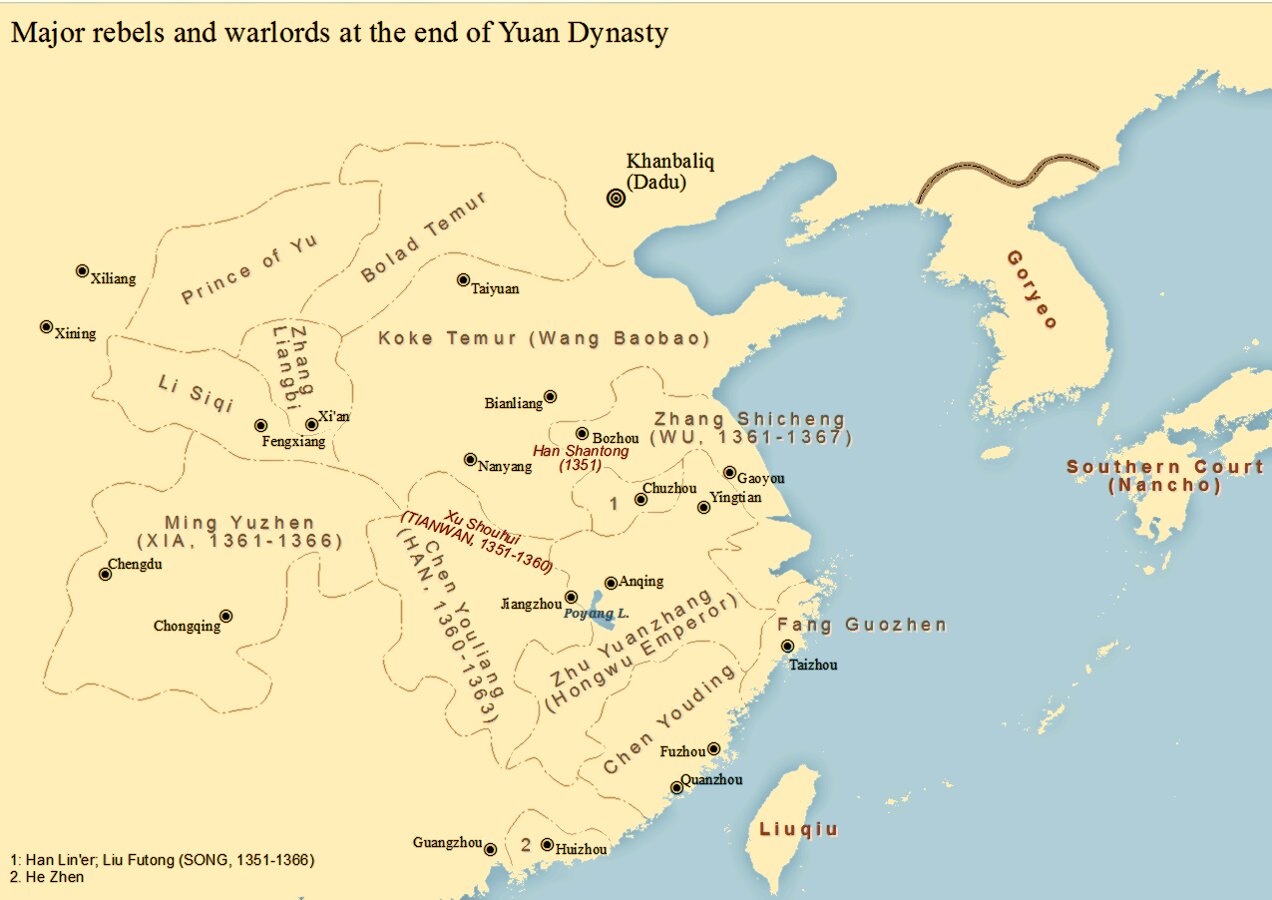
The Red Turban Rebellions. The Red Turban Rebellions (1351-1368) were the great uprisings that destroyed Mongol rule in China. By the 1340s the Yuan dynasty was rotting: floods of the Yellow River, famine, paper-money inflation, and the resentment of Chinese scholars and peasants at Mongol and Muslim privilege. In 1344 the river burst its banks and the dynasty conscripted 150,000 laborers to re-channel it - perfect tinder for revolt.
The spark was the White Lotus, a Buddhist folk sect preaching the coming of Maitreya, the Buddha of the future, and the restoration of the Chinese Song dynasty. Its leaders Han Shantong - proclaimed the reincarnated Ming Wang ('King of Light') - and Liu Futong raised the standard in 1351, their armies wearing red headscarves that gave the movement its name. The Red Turbans soon split into two great movements: the northern, under Liu Futong and the child 'Little Prince' Han Lin'er, which retook Kaifeng and raided as far as the Yuan summer capital; and the southern, based in Hubei and the Yangzi valley.
The Yuan could not cope: its own generals became warlords, and its chancellor Toghto, on the point of victory, was dismissed in a court intrigue (1354) and the imperial armies dissolved into rival camps. Into the vacuum stepped a Red Turban novice-monk turned warlord, Zhu Yuanzhang, who from his base at Nanjing systematically destroyed his rival rebel kings - Chen Youliang at the great lake battle of Poyang (1363), then Zhang Shicheng - and unified the south.
In 1368 Zhu Yuanzhang declared the Ming dynasty and marched north; the last Yuan emperor fled to the steppe, and Mongol rule over China ended after less than a century. The Red Turbans' legacy was double: the Ming dynasty itself, and a permanent Chinese fear and fascination with secret-society millenarian revolt.
 World History Encyclopedia: Hongwu Emperor
World History Encyclopedia: Ming Dynasty
 Humanities LibreTexts: Decline of the Yuan Dynasty