 Go Back

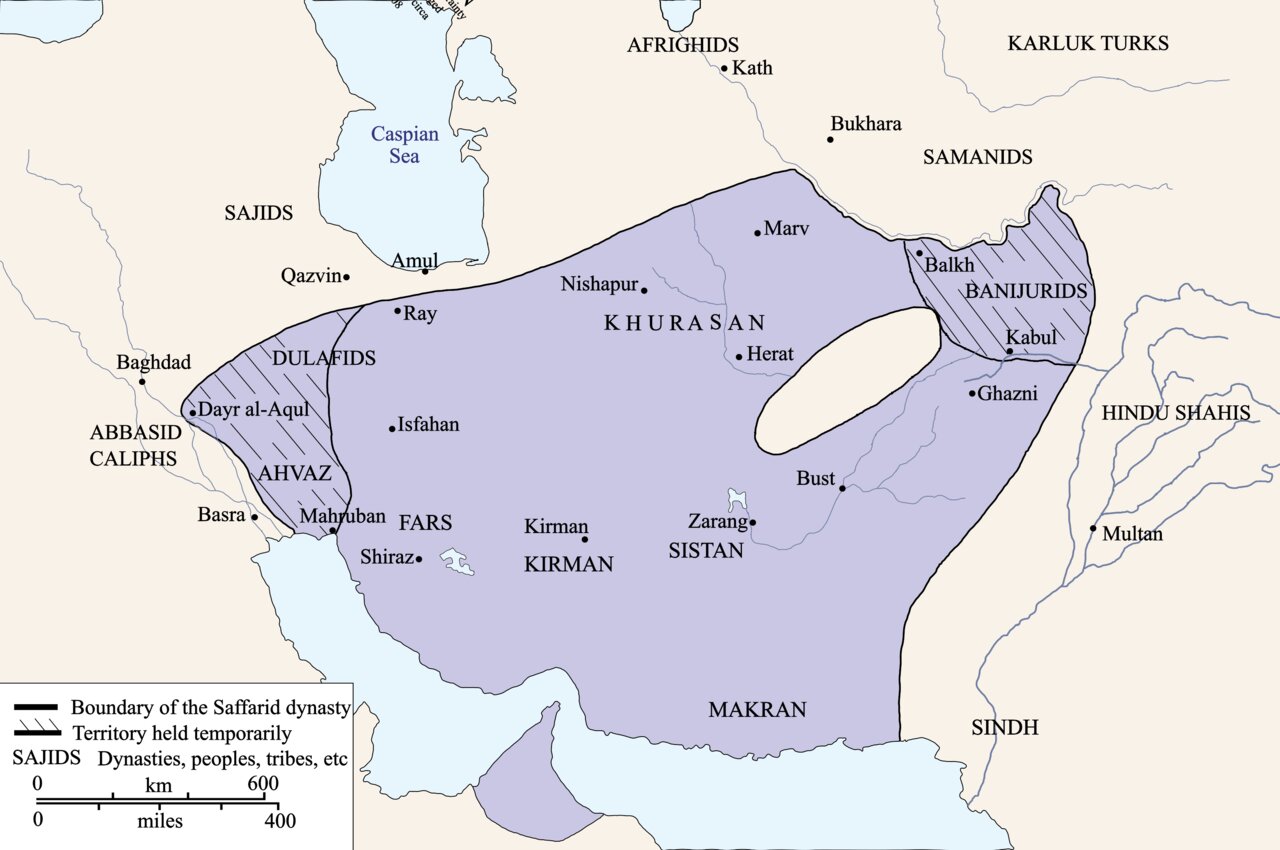
The Saffarid Dynasty. The Saffarids (861-1003) were the first of the new Iranian dynasties to break the Abbasid order by force, and their founder's story is one of the most remarkable rises of the age: Ya'qub ibn al-Layth al-Saffar, a coppersmith (saffar) from Sistan (southeastern Iran), began as the leader of an 'ayyar vigilante band fighting the Kharijites, was made governor of Sistan by the caliph's governor of Khorasan, and in 861 set out to build an empire of his own.
Ya'qub conquered with startling speed: all of Sistan and Kerman, then Fars, and in 873 he took Nishapur and ended the Tahirid dynasty, bringing Khorasan under his rule. Twice he marched on Baghdad itself to claim the caliphate's heartland, and only a decisive Abbasid victory at Dayr al-Aqul (876), led by the caliph's brother al-Muwaffaq, stopped him. He died in 879, still ruling everything east of Iraq.
His brother Amr (r. 879-901) ruled more cautiously, accepting investiture from the caliph, but overreached in 900 by challenging the Samanids for Transoxiana: defeated and captured at Balkh, he was sent in chains to Baghdad and executed. Thereafter the Saffarids shrank back to their Sistan homeland, surviving for another century as local rulers - sometimes Samanid, sometimes Ghaznavid vassals - until the line ended around 1003.
The Saffarids matter beyond their brief empire: they proved that eastern Iranian rulers could defy Baghdad, opening the age of the Iranian successor dynasties; their court revived New Persian poetry - Ya'qub was among the first rulers praised in Persian verse - and their Sistan homeland preserved a distinct Iranian-Islamic frontier culture, celebrated in the epic traditions of the Shahnameh.
 Britannica: Saffarid dynasty
 Encyclopaedia Iranica: Saffarids
Encyclopaedia Iranica: Ya'qub b. Layth b. Mo'addal