 Go Back

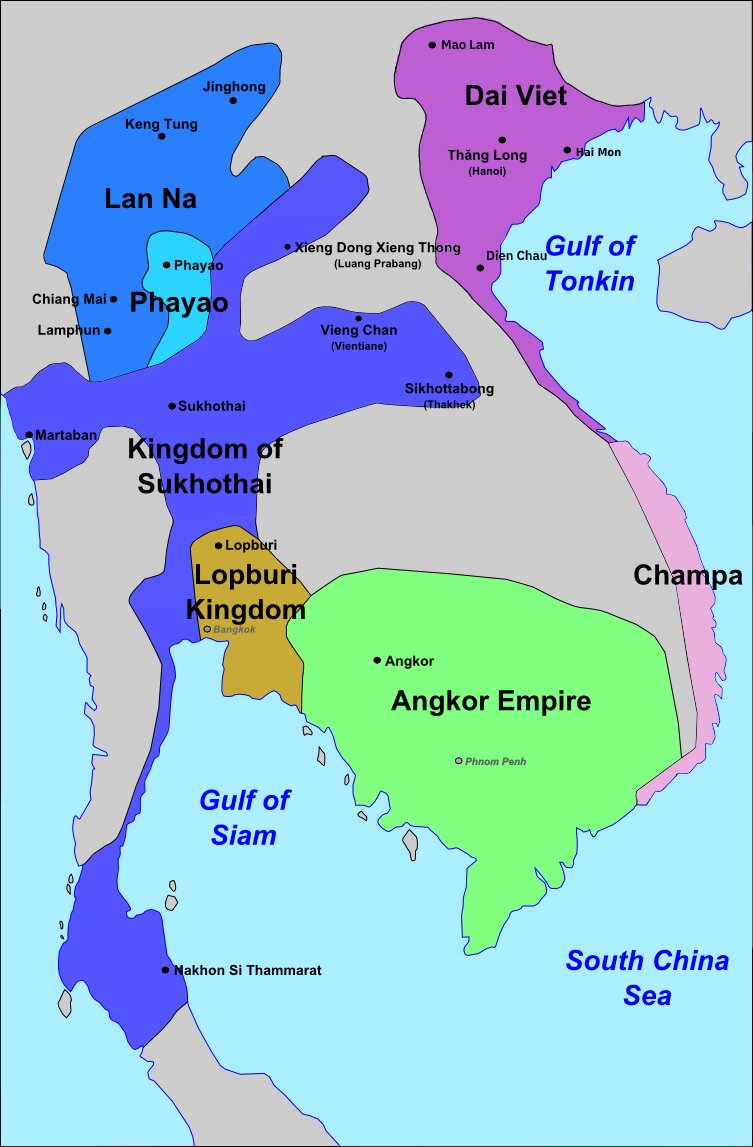
The Sukhothai Kingdom. Sukhothai (1238-1438) is remembered as the first true kingdom of the Thai people. When Angkorian Khmer power waned in the 13th century, two Thai chieftains seized the town of Sukhothai ('Dawn of Happiness') in the Chao Phraya valley in 1238, and one of their sons, Si Inthrathit, became its first king. Under his son Ramkhamhaeng the Great (r. c. 1279-1298), Sukhothai expanded to rule much of what is now Thailand and Laos, from Luang Prabang to the Malay Peninsula.
Ramkhamhaeng is the culture-hero of Thai history. His famous inscription of 1292 - the earliest known writing in Thai - describes an ideal kingdom where the king sat accessible on his throne to hear any petition, trade was untaxed, 'whoever wants to trade in elephants, trades; whoever wants to trade in horses, trades', and the people lived in plenty. Whatever its idealization, the inscription records real achievements: the Thai alphabet created or codified under his patronage, the adoption of Theravada Buddhism from Ceylon, and a diplomatic court that sent embassies to Mongol China.
Sukhothai's artisans produced the kingdom's enduring monuments: the temple-cities of Sukhothai and Si Satchanalai with their graceful lotus-bud chedis, and the celebrated Sukhothai school of Buddhist art - the serene walking-Buddha images, unique in world art - while its kilns exported Sawankhalok ceramics across Southeast Asia.
After Ramkhamhaeng the kingdom shrank as his successors proved pious but unwarlike, and the vigorous new Thai power of Ayutthaya to the south eclipsed it: Sukhothai became its tributary in 1378 and was fully absorbed by 1438. Later Thai national memory made Sukhothai the idealized first chapter of the nation - its script, its Buddhism, and its model of the paternal Buddhist king.
 Britannica: Sukhothai kingdom
 World History Encyclopedia: Sukhothai
 Humanities LibreTexts: Thai Art