 Go Back

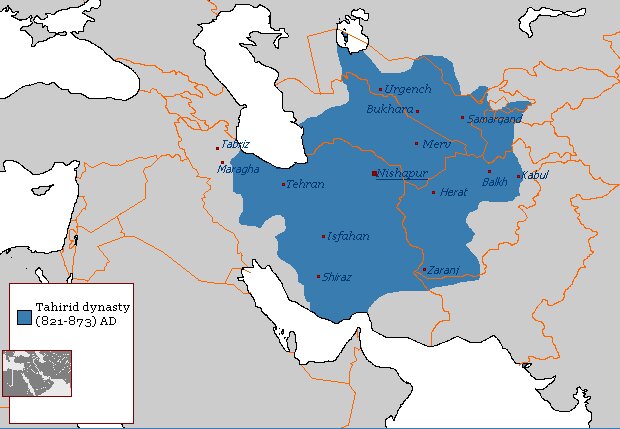
The Tahirid Dynasty. The Tahirids (821-873) were the first hereditary dynasty of the Abbasid era and the model for all that followed. Their founder, Tahir ibn al-Husayn, was the general who won the great civil war (809-813) for the caliph al-Ma'mun, commanding his Khorasanian army at the siege of Baghdad; his reward was the governorship of Khorasan in 821, with its capital at Nishapur, and when he died suddenly the next year, the caliph let his son Talha inherit - an unprecedented concession of hereditary rule.
For half a century the Tahirids ruled Khorasan and the east - Transoxiana, Sistan, and the frontiers of the steppe - with practical independence: they omitted the caliph's name from the Friday prayer until warned, appointed their own officials, and kept their own army, while sending regular tribute and the caliph's gifts of investiture flowed back east. Tahir's descendants also supplied the caliphs with their other pillar of power in the west: the Tahirid Ishaq and his heirs commanded the security (shurta) of Baghdad itself for decades.
The dynasty's rule is remembered as a golden interlude of order: Nishapur flourished as a center of Sunni scholarship and trade, irrigation and agriculture were maintained, and the frontier war against the steppe was pressed by Tahirid governors. But as the Samarra caliphate slid into military anarchy, the dynasty's grip loosened, and in 873 the coppersmith-adventurer Ya'qub al-Saffar took Nishapur almost unopposed, ending Tahirid rule.
The Tahirids' historical significance is structural: they established the pattern of the hereditary, nominally caliph-loyal provincial dynasty through which the Abbasid Empire would actually be governed for two centuries - the pattern the Saffarids, Samanids, and ultimately the Seljuks and their atabegs would follow.
 Encyclopaedia Iranica: Taherids
Encyclopaedia Iranica: Khorasan in the Taherid and Samanid Periods
 Britannica: Saffarid dynasty