 Go Back

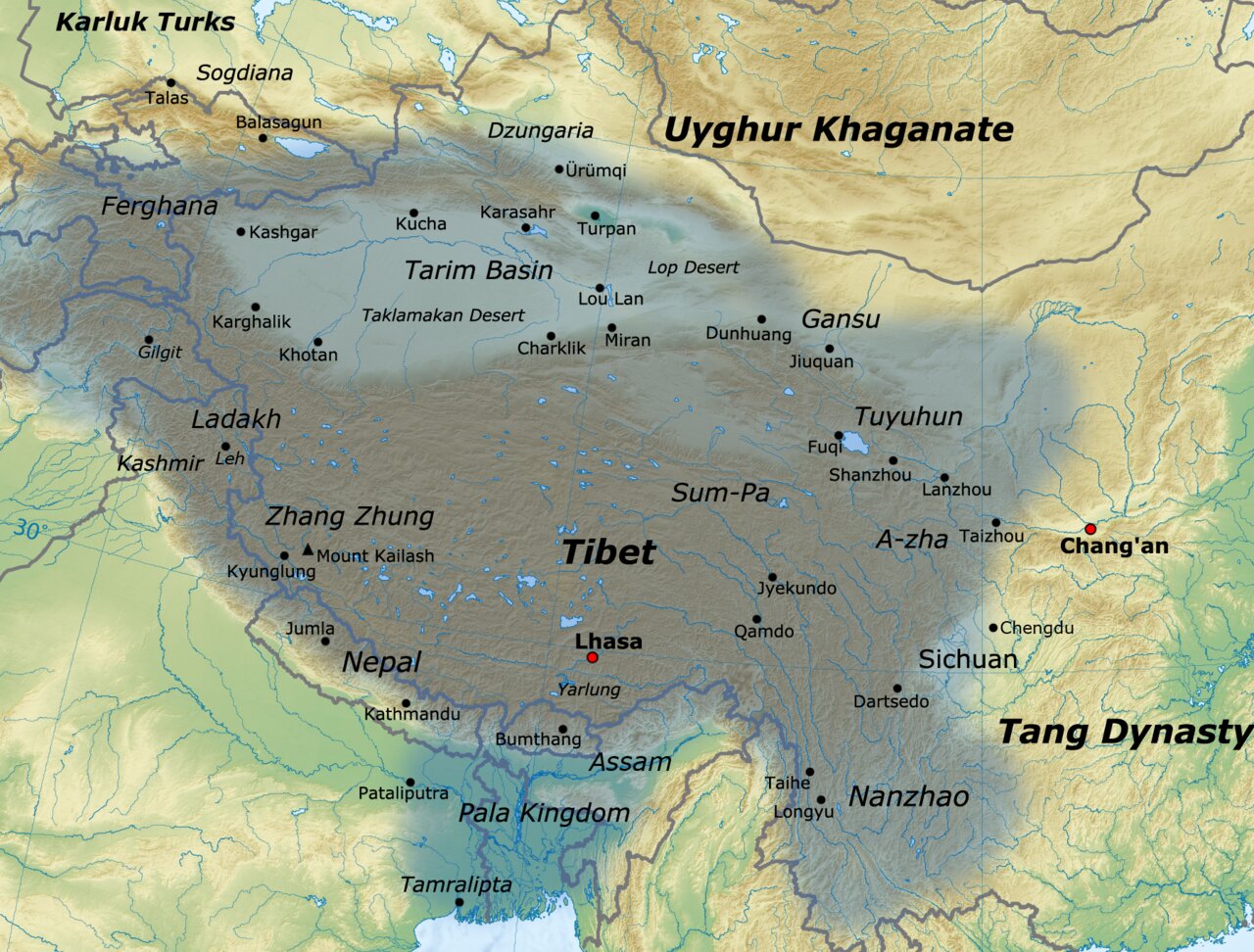
The Tibetan Empire. The Tibetan Empire (618-842) rose with startling speed to become one of the great powers of Asia. Its founder, Songtsen Gampo (r. c. 618-650), united the clans of the Yarlung valley, moved his capital to Lhasa, gave Tibet its written script (created by his minister Thonmi Sambhota from Indian models), and forced both Nepal and Tang China to send him royal brides - the Nepali Bhrikuti and the Chinese Wencheng, to whom Tibetan tradition credits the coming of Buddhism.
Under Songtsen Gampo's successors the empire burst out of the plateau. Tibetan armies fought the Tang for the Tarim oases and the Silk Road, seized the kingdom of Gilgit, briefly occupied the Chinese capital Chang'an itself in 763 (installing a puppet emperor), and ruled an empire stretching from the Pamirs to Gansu, from the Tarim Basin to the borders of Bengal. The treaty pillar of 821-822, still standing in Lhasa, records peace between Tibet and China as equals - 'the nephew and the uncle'.
The empire's court was cosmopolitan: Buddhist monks from India and China, Nestorian Christians, Manicheans and Bon priests all appear at the Tibetan court, and Tibetan documents survive from Dunhuang to Turfan. Under Trisong Detsen (r. 755-797) Buddhism became the state religion - the founding of Samye monastery (c. 779), Tibet's first, and the legendary debate at Samye between Indian and Chinese Buddhist schools decided Tibet for Indian-style Mahayana.
The empire's end was sudden: the anti-Buddhist king Langdarma was assassinated in 842 and his sons' civil war shattered the realm, which fragmented into local kingdoms for four centuries. But the imperial age fixed Tibet's identity: its script, its Buddhism (revived in the 'second dissemination'), its epic memory of Songtsen Gampo, and the ruins of its royal tombs in the Yarlung valley.
 Britannica: Srong-brtsan-sgam-po
 Humanities LibreTexts: Tibetan Empire (618-842 CE)
 The Metropolitan Museum of Art: Arts of the Greater Himalayas: Kashmir, Tibet, and Nepal