 Go Back

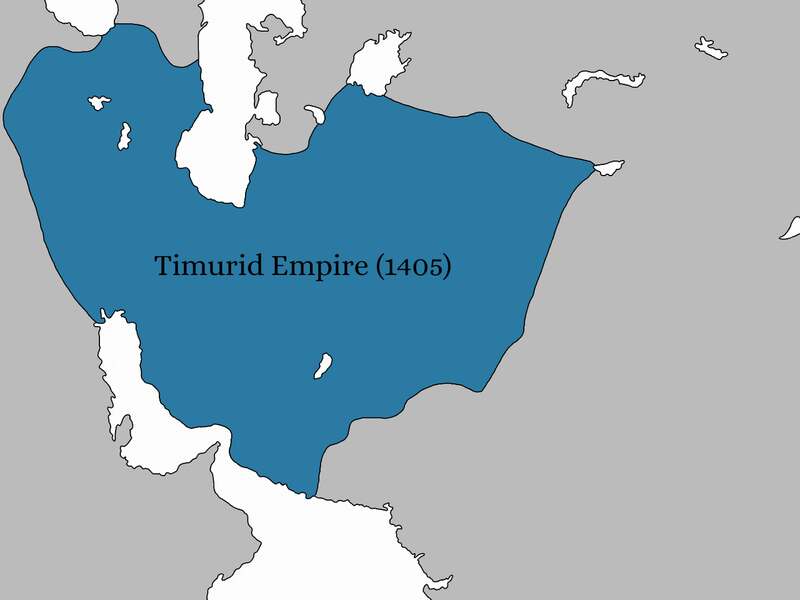
The Timurid Empire. The Timurid Empire (1370-1507) was the last great nomadic conquest empire of Central Asia - the creation of Timur, known to the West as Tamerlane, a warlord of the Turkicized Mongol Barlas tribe who built an empire from Delhi to Anatolia in thirty-five years of unbroken campaigning. Unable to claim descent from Genghis Khan, Timur married into the dynasty, took the title Gurkani - 'son-in-law' - and ruled through puppet khans while holding all real power himself from his magnificent capital at Samarkand.
Timur saw himself as the restorer of the Mongol Empire, and his campaigns revived its methods as well as its borders. He crushed his former protégé Tokhtamysh and the Golden Horde, sacked Baghdad and Damascus - where the historian Ibn Khaldun met him in 1401 and found him both terrifying and brilliant - and in 1398 descended on Delhi, leaving the city a ruin from which the Delhi Sultanate never recovered. His most consequential victory came at Ankara in 1402, where he defeated and captured the Ottoman sultan Bayezid I, throwing the rising Ottoman state into a decade of civil war and buying Constantinople another fifty years. He died in 1405, marching to conquer China.
His successors traded conquest for culture, and the result was the Timurid Renaissance. Timur's son Shah Rukh (r. 1405-1447) ruled from Herat, which he made one of the most refined courts in the Islamic world, a center of miniature painting, calligraphy, and Persian poetry. Shah Rukh's son Ulugh Beg was himself an astronomer: his observatory at Samarkand produced star tables of unmatched precision for their era. A century later, the court of Husayn Bayqara at Herat gave the world the painter Bihzad and the poet Jami - the final flowering of the classical Persian tradition.
The empire's political story was briefer than its cultural one. The Timurids lost Persia to the Aq Qoyunlu Turkomans by 1469, and in 1500-1507 the Uzbeks under Shaybani Khan took Samarkand and Herat. But the dynasty had one more act: the young Timurid prince Babur, driven from his Central Asian homeland, turned east and in 1526 conquered Delhi - founding the Mughal Empire, which would rule India for three centuries. Through the Mughals, Timur's bloodline and his Persianate culture outlasted his empire by four hundred years.
 Britannica: Timurid dynasty
 Humanities LibreTexts: 15.2: Timurid
 The Metropolitan Museum of Art: The Art of the Timurid Period (ca. 1370–1507)
 British Museum: Collections Online