 Go Back

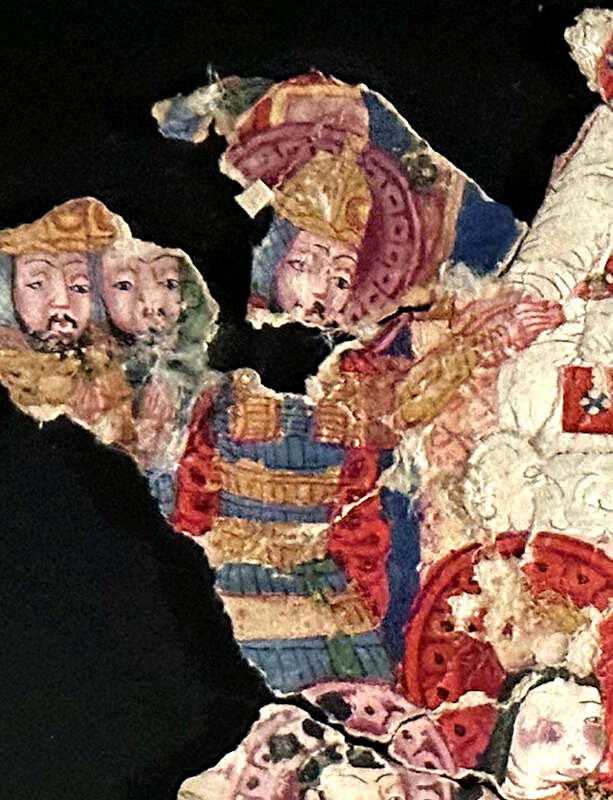
The Uyghur Khaganate. The Uyghur Khaganate (744-840) ruled the steppe for a century between the Göktürks and the Mongols - and it broke the steppe's oldest rule, for the Uyghurs built cities. Calling themselves the Toquz Oghuz, the Nine Tribes, they rose in 744 when a Uyghur-Karluk alliance destroyed the Basmyls who had toppled the Second Göktürk Khaganate; the next year they killed the last Göktürk khagan and sent his head to the Tang emperor. From their capital at Ordu-Baliq on the Orkhon - a walled city on the open steppe - the Uyghur khagans ruled, in the words of the Tang histories, 'the entire territory of the ancient Xiongnu'.
The Uyghurs built their empire on an unusual foundation: not raiding China but rescuing it. When the An Lushan rebellion nearly destroyed the Tang dynasty in 755, it was Uyghur cavalry that retook the capitals Chang'an and Luoyang - and the Uyghurs collected their price in silk: tens of thousands of rolls a year, a horse trade fixed at forty rolls of silk per horse, marriage alliances with Tang princesses, and 'guest' status for Uyghurs in China. When the Tang retreated from Central Asia after their defeat by the Arabs at Talas in 751, the Uyghurs were left the dominant power of the Silk Road, and Sogdian merchants flocked to their court.
In 762 the khagan Bögü, campaigning in China, encountered Manichaean priests - and converted. It was an astonishing choice: a steppe empire adopting, as its state religion, the Persian faith of light and darkness, a religion of books and merchants rather than warriors. The khaganate's official religion became Manichaeism, practiced alongside Tengrism, Buddhism, and Nestorian Christianity - an empire of unusual religious diversity even by steppe standards.
The end came with terrible speed. Famine, epidemic, and a killing winter in 839-840 gutted the herds the empire lived on, and in 840 the Yenisei Kyrgyz - invited in by a rebellious Uyghur minister - swept down with 80,000 horsemen, sacked and burned Ordu-Baliq, and destroyed the khaganate in a single campaign. The Uyghurs fled south and west as refugees; in the oases of Gansu and the Tarim Basin they built new states, the Gansu Uyghur Kingdom and the Kingdom of Qocho, that carried Uyghur culture on for centuries.
 Britannica: Uyghur confederacy
 UNESCO World Heritage Centre: Silk Roads: the Routes Network of Tian-shan Corridor (nomination dossier)
 Encyclopaedia Iranica: KHAGAN
 Wikipedia: Uyghur Khaganate