 Go Back

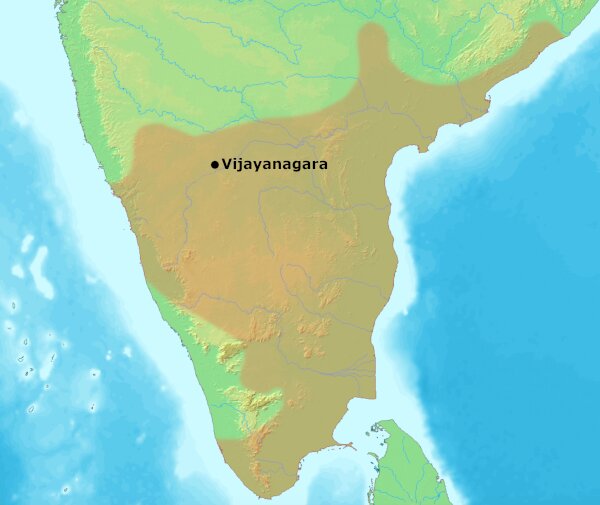
The Vijayanagara Empire. The Vijayanagara Empire (1336-1646) was the last great Hindu empire of South India, founded - tradition says on the advice of the sage Vidyaranya - by the brothers Harihara and Bukka of the Sangama family on the banks of the Tungabhadra River. From their fortress capital, the city of Vijayanagara ('City of Victory', modern Hampi), they and their successors ruled the peninsula south of the Krishna, defending and consciously reviving Hindu kingship against the Muslim sultanates of the Deccan.
The empire reached its height under Krishnadevaraya (r. 1509-1529) of the Tuluva dynasty: he humbled the Gajapatis of Orissa and the sultanate of Bijapur, took the Raichur Doab, and presided over a court where Telugu literature (the 'eight elephants' of poets) and temple-building flourished - he is still a folk hero of South India. Foreign visitors were stunned by the capital: the Portuguese travelers Paes and Nuniz described a vast city of bazaars, irrigation tanks, and temple complexes, richer than any they knew in Europe.
Vijayanagara's wealth came from control of South India's trade: its ports shipped pepper, textiles and horses (bought from the Arabs and Portuguese, vital against the Deccan cavalry), and its kings built enormous irrigation works in the dry interior. Society was organized around the nayakas, warrior-governors who held land in return for military service - efficient in expansion, but a centrifugal force once royal power weakened.
The end came at Talikota (1565), where the combined Deccan sultanates - Bijapur, Golconda, Ahmadnagar, Bidar - crushed the imperial army, killed the regent Aliya Rama Raya, and sacked the great city, which was abandoned to become the haunting ruins of Hampi. A diminished court survived at Penukonda and Chandragiri until 1646, but the empire was over. Its nayaka heirs ruled South India for generations, and Hampi is today a UNESCO World Heritage site.
 Britannica: Vijayanagar
 Humanities LibreTexts: Vijayanagar Empire
 Encyclopaedia Iranica: Deccan: Political and Literary History